Back to the main page Back to category Other Pianos and Keyboards
musical instrument details
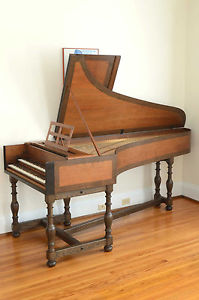
2 Manual Saxon Harpsichord by Willard Martin: Opus 291, 1989
Estimated price for orientation: 24 000 $
Category: Other Pianos and Keyboards
Class:
Description Brand: Willard Martin of Bethlehem, Pennsylvania Country/Region of Manufacture: United States MPN: Does Not Apply Keyboard compass: FF to f3 (61 notes - 60 when transposed) Model: Saxon Double Pitch of A above middle C: 415 Hz, with shifting 390 Hz or 440 Hz UPC: Does not apply
This is a wonderful instrument. It can be identified as built in the early 18th century Saxon style by a number of characteristics, most obviously the length and shape, featuring a reversing sweep in its bentside. In the world of harpsichords it is referred to as a Saxon Double. This eBay listing is by its second owner, who acquired it in 1991. Among its various delightful aspects is the decorative painting of the soundboard by the artist Pamela Gladding, whose work in this art form is held in high esteem. It perhaps bears pointing out that the historic term Saxon, as used here, refers to an area of Europe somewhat more southerly, and altogether broader geographically, than the present-day German state of Saxony.A great deal of pleasure has been derived from the sound of this harpsichord, and a dropbox link with sound recordings is . They are single-microphone recordings. Listeners - please be leery of listening to the recordings on any device which automatically adjusts the playback volume as the track is playing: that can produce ugly results, because such a device tries to "correct" the natural decay in the sound of a harpsichord after each string is plucked! One is a performance of Bach Cantate 140 - showing the effectiveness of the harpsichord in a concert setting. There are three solo pieces, recorded in a residential setting: the first is Handel's Air and (five) Variations "The Harmonious Blacksmith"; the second is a portion of Scheidt's Tabulatura Nova Part II Number 2 "Echo";. the third is Gibbons's Pavana, no. 292 from the Fitzwilliam Virginal Book Volume II. (Incidentally, it shouldn't be necessary to have a dropbox membership to access a recording: it should be possible to bypass any such prompts!) The sound is relatively "full" by harpsichord standards, since it was "voiced-up" at the request of the original owner for use in concerts.
There are three rows of jacks. The lower keyboard has strings at 8-foot and 4-foot pitch, selectable individually or together. The upper keyboard has a permanently-on 8-foot register, the sound of which is subtly but noticeably "lighter" than the lower 8-foot. There is a rather delightful lute stop - exquisitely regulated - which can be applied to modify - dampen, if you will - the sound of the lower 8-foot. One intriguing detail is that the "feel" or "touch" at the keys is also modified when the lute stop is applied. The keyboards can be coupled with a so-called "shove" coupler. With all registers playing and music of demanding texture the sound is - to borrow a French word to describe this German instrument - formidable!Three different pitches are available by shifting the keyboards from their center position. The main pitch is A = 415; high is A = 440; low is A = 390. (If unequal temperament is to be used the keyboards need to be in the correct position before tuning.)The instrument has received careful maintenance by the owner/seller. Willard Martin, the maker, took time to see it when delivering another instrument in town in 2003, and provided much-valued instruction on its technical regulation. Notes were made, and this information will be imparted to the buyer. In the instrument's evolved state there are a few relatively minor soundboard cracks, but they are not noticeable soundwise. According to the maker, from his experience fixing cracks of this kind involves opening up access through the bottom of the harpsichord. There has been, and currently is, no perceived need to do so in this case. A tool and supplies kit, supplied by the maker and augmented, goes with the harpsichord - as does a fitted soft protective cover, secured by lacing on the underside.
The harpsichord will be delivered free of charge to any location in the United States east of the Mississippi. For delivery to other locations, including globally, freight arrangements are negotiable. It is anticipated that a prospective purchaser may wish to see it before making a commitment. The sale will comply with the policies and rules of eBay.
Dimensions and weights (if any) shown in the "Shipping" tab apply to the harpsichord in its assembled state, being reduced to a hypothetical single package (albeit without any crating). That information should not be relied upon to compute shipping charges by a freight network because, for one thing the stand would be disassembled, and for another a crate would modify both shipping dimensions and shipping weight. More complete information for moving and setting up in the course of normal use is as follows:Dimensions...
Stand (without being disassembled): length 75-5/8"; width 34-1/4"; height 25-1/2".
Harpsichord: length 93-1/4"; width 37-1/4"; height including hinges 11-5/8".Weights...
Stand: 48-1/4 lb.
Harpsichord, as prepared for moving: 132-1/4 lb.*
Music rack and stick for lid: 4-1/4 lb. * Includes end board (to protect keyboards) and protective cover.Please don't hesitate to use eBay's messaging system to ask questions. Thank you for your interest.
Description
| Brand: | Willard Martin of Bethlehem, Pennsylvania | Country/Region of Manufacture: | United States |
| MPN: | Does Not Apply | Keyboard compass: | FF to f3 (61 notes - 60 when transposed) |
| Model: | Saxon Double | Pitch of A above middle C: | 415 Hz, with shifting 390 Hz or 440 Hz |
| UPC: | Does not apply |
This is a wonderful instrument. It can be identified as built in the early 18th century Saxon style by a number of characteristics, most obviously the length and shape, featuring a reversing sweep in its bentside. In the world of harpsichords it is referred to as a Saxon Double. This eBay listing is by its second owner, who acquired it in 1991. Among its various delightful aspects is the decorative painting of the soundboard by the artist Pamela Gladding, whose work in this art form is held in high esteem. It perhaps bears pointing out that the historic term Saxon, as used here, refers to an area of Europe somewhat more southerly, and altogether broader geographically, than the present-day German state of Saxony.A great deal of pleasure has been derived from the sound of this harpsichord, and a dropbox link with sound recordings is . They are single-microphone recordings. Listeners - please be leery of listening to the recordings on any device which automatically adjusts the playback volume as the track is playing: that can produce ugly results, because such a device tries to "correct" the natural decay in the sound of a harpsichord after each string is plucked! One is a performance of Bach Cantate 140 - showing the effectiveness of the harpsichord in a concert setting. There are three solo pieces, recorded in a residential setting: the first is Handel's Air and (five) Variations "The Harmonious Blacksmith"; the second is a portion of Scheidt's Tabulatura Nova Part II Number 2 "Echo";. the third is Gibbons's Pavana, no. 292 from the Fitzwilliam Virginal Book Volume II. (Incidentally, it shouldn't be necessary to have a dropbox membership to access a recording: it should be possible to bypass any such prompts!) The sound is relatively "full" by harpsichord standards, since it was "voiced-up" at the request of the original owner for use in concerts.
There are three rows of jacks. The lower keyboard has strings at 8-foot and 4-foot pitch, selectable individually or together. The upper keyboard has a permanently-on 8-foot register, the sound of which is subtly but noticeably "lighter" than the lower 8-foot. There is a rather delightful lute stop - exquisitely regulated - which can be applied to modify - dampen, if you will - the sound of the lower 8-foot. One intriguing detail is that the "feel" or "touch" at the keys is also modified when the lute stop is applied. The keyboards can be coupled with a so-called "shove" coupler. With all registers playing and music of demanding texture the sound is - to borrow a French word to describe this German instrument - formidable!Three different pitches are available by shifting the keyboards from their center position. The main pitch is A = 415; high is A = 440; low is A = 390. (If unequal temperament is to be used the keyboards need to be in the correct position before tuning.)The instrument has received careful maintenance by the owner/seller. Willard Martin, the maker, took time to see it when delivering another instrument in town in 2003, and provided much-valued instruction on its technical regulation. Notes were made, and this information will be imparted to the buyer. In the instrument's evolved state there are a few relatively minor soundboard cracks, but they are not noticeable soundwise. According to the maker, from his experience fixing cracks of this kind involves opening up access through the bottom of the harpsichord. There has been, and currently is, no perceived need to do so in this case. A tool and supplies kit, supplied by the maker and augmented, goes with the harpsichord - as does a fitted soft protective cover, secured by lacing on the underside.
The harpsichord will be delivered free of charge to any location in the United States east of the Mississippi. For delivery to other locations, including globally, freight arrangements are negotiable. It is anticipated that a prospective purchaser may wish to see it before making a commitment. The sale will comply with the policies and rules of eBay.
Dimensions and weights (if any) shown in the "Shipping" tab apply to the harpsichord in its assembled state, being reduced to a hypothetical single package (albeit without any crating). That information should not be relied upon to compute shipping charges by a freight network because, for one thing the stand would be disassembled, and for another a crate would modify both shipping dimensions and shipping weight. More complete information for moving and setting up in the course of normal use is as follows:Dimensions...
Stand (without being disassembled): length 75-5/8"; width 34-1/4"; height 25-1/2".
Harpsichord: length 93-1/4"; width 37-1/4"; height including hinges 11-5/8".Weights...
Stand: 48-1/4 lb.
Harpsichord, as prepared for moving: 132-1/4 lb.*
Music rack and stick for lid: 4-1/4 lb. * Includes end board (to protect keyboards) and protective cover.Please don't hesitate to use eBay's messaging system to ask questions. Thank you for your interest.
There are three rows of jacks. The lower keyboard has strings at 8-foot and 4-foot pitch, selectable individually or together. The upper keyboard has a permanently-on 8-foot register, the sound of which is subtly but noticeably "lighter" than the lower 8-foot. There is a rather delightful lute stop - exquisitely regulated - which can be applied to modify - dampen, if you will - the sound of the lower 8-foot. One intriguing detail is that the "feel" or "touch" at the keys is also modified when the lute stop is applied. The keyboards can be coupled with a so-called "shove" coupler. With all registers playing and music of demanding texture the sound is - to borrow a French word to describe this German instrument - formidable!Three different pitches are available by shifting the keyboards from their center position. The main pitch is A = 415; high is A = 440; low is A = 390. (If unequal temperament is to be used the keyboards need to be in the correct position before tuning.)The instrument has received careful maintenance by the owner/seller. Willard Martin, the maker, took time to see it when delivering another instrument in town in 2003, and provided much-valued instruction on its technical regulation. Notes were made, and this information will be imparted to the buyer. In the instrument's evolved state there are a few relatively minor soundboard cracks, but they are not noticeable soundwise. According to the maker, from his experience fixing cracks of this kind involves opening up access through the bottom of the harpsichord. There has been, and currently is, no perceived need to do so in this case. A tool and supplies kit, supplied by the maker and augmented, goes with the harpsichord - as does a fitted soft protective cover, secured by lacing on the underside.
The harpsichord will be delivered free of charge to any location in the United States east of the Mississippi. For delivery to other locations, including globally, freight arrangements are negotiable. It is anticipated that a prospective purchaser may wish to see it before making a commitment. The sale will comply with the policies and rules of eBay.
Dimensions and weights (if any) shown in the "Shipping" tab apply to the harpsichord in its assembled state, being reduced to a hypothetical single package (albeit without any crating). That information should not be relied upon to compute shipping charges by a freight network because, for one thing the stand would be disassembled, and for another a crate would modify both shipping dimensions and shipping weight. More complete information for moving and setting up in the course of normal use is as follows:Dimensions...
Stand (without being disassembled): length 75-5/8"; width 34-1/4"; height 25-1/2".
Harpsichord: length 93-1/4"; width 37-1/4"; height including hinges 11-5/8".Weights...
Stand: 48-1/4 lb.
Harpsichord, as prepared for moving: 132-1/4 lb.*
Music rack and stick for lid: 4-1/4 lb. * Includes end board (to protect keyboards) and protective cover.Please don't hesitate to use eBay's messaging system to ask questions. Thank you for your interest.