Back to the main page Back to category Tubas
musical instrument details
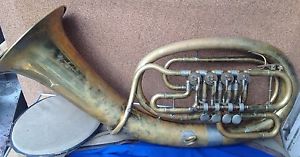
Collectible Brass Musical Instrument Oval Baritone or Tenorhorn Amati Kraslice
Estimated price for orientation: 550 $
Category: Tubas
Class:
Description Brand: Amati Country/Region of Manufacture: Czech Republic Era: WWII Model: Kraslice Skill Level: Professional
We offer you this fine old tuba or Euphonium (Baritone or Tenorhorn) by the famous brand Amati. I am not a musician or a musical instrument specialist, so I can't tell the exact condition of the tuba. In fact, I can't tell exactly if it's a tuba, Euphonium or Baritone/Tenerhorn. So if you know what exactly this is, please let me know.As you can see on the photos, there re some areas that need to be repaired. The keys may need some restoration too. Anyways, the Amati instruments have always been top-quality musical gear, so the restoration of this one should worth it. The Czech are the major builders of these types of instruments- Cveny and Amati are both Czech if I remember correctly. There is no easy way to tell who made the instrument aside from maker marks (which often include the city of manufacture or can be found online). The maker is typically not very important with these instruments, but always good to mention if known.What is tricker is the difference between an Oval Tenorhorn, Oval Baritone, and Oval Euphonium (also called "Kaiser Baritone", most confusingly). The difference is extremely subtle as all three instruments look nearly identical, so it is often best to list these items as "Baritone or Tenorhorn". Essentially, Euphoniums have thicker "necks", while Baritones and Tenorhorns have thinner "necks" (the "neck" is the flare leading up to the bell). Euphoniums *tend* to have larger bores (the tubing on the whole instrument is in general, wider) as well. This is all really semantics.When listing such musical instruments, I suggesting using "Oval" , which is more widely recognized. Thus, a good listing would be something like "Oval Baritone or Tenorhorn by [maker]". Remember, there can also be smaller versions (althorns) that look identical but are smaller (so keep those measurements I sent you in mind). It is very rare to find a tuba in an oval wrap- it would likely be upwards of 40" in length.From Wikipedia, the free encyclopediaThe Euphonium is a , -voiced that derives its name from the word euphonos,meaning "well-sounding" or "sweet-voiced" (eu means "well" or "good" and phonos means "of sound", so "of good sound"). The euphonium is a valved instrument; nearly all current models are , though models do exist. The euphonium is a non- instrument known for its distinctive tone color, wide range, variety of character and agility. A person who plays the euphonium is sometimes called a euphoniumist, euphophonist, or a euphonist, while British players often colloquially refer to themselves as euphists, or euphologists. Similarly, the instrument itself is often referred to as eupho or euph.
Description
| Brand: | Amati | Country/Region of Manufacture: | Czech Republic |
| Era: | WWII | Model: | Kraslice |
| Skill Level: | Professional |
We offer you this fine old tuba or Euphonium (Baritone or Tenorhorn) by the famous brand Amati. I am not a musician or a musical instrument specialist, so I can't tell the exact condition of the tuba. In fact, I can't tell exactly if it's a tuba, Euphonium or Baritone/Tenerhorn. So if you know what exactly this is, please let me know.As you can see on the photos, there re some areas that need to be repaired. The keys may need some restoration too. Anyways, the Amati instruments have always been top-quality musical gear, so the restoration of this one should worth it. The Czech are the major builders of these types of instruments- Cveny and Amati are both Czech if I remember correctly. There is no easy way to tell who made the instrument aside from maker marks (which often include the city of manufacture or can be found online). The maker is typically not very important with these instruments, but always good to mention if known.What is tricker is the difference between an Oval Tenorhorn, Oval Baritone, and Oval Euphonium (also called "Kaiser Baritone", most confusingly). The difference is extremely subtle as all three instruments look nearly identical, so it is often best to list these items as "Baritone or Tenorhorn". Essentially, Euphoniums have thicker "necks", while Baritones and Tenorhorns have thinner "necks" (the "neck" is the flare leading up to the bell). Euphoniums *tend* to have larger bores (the tubing on the whole instrument is in general, wider) as well. This is all really semantics.When listing such musical instruments, I suggesting using "Oval" , which is more widely recognized. Thus, a good listing would be something like "Oval Baritone or Tenorhorn by [maker]". Remember, there can also be smaller versions (althorns) that look identical but are smaller (so keep those measurements I sent you in mind). It is very rare to find a tuba in an oval wrap- it would likely be upwards of 40" in length.
From Wikipedia, the free encyclopedia
The Euphonium is a , -voiced that derives its name from the word euphonos,meaning "well-sounding" or "sweet-voiced" (eu means "well" or "good" and phonos means "of sound", so "of good sound"). The euphonium is a valved instrument; nearly all current models are , though models do exist. The euphonium is a non- instrument known for its distinctive tone color, wide range, variety of character and agility. A person who plays the euphonium is sometimes called a euphoniumist, euphophonist, or a euphonist, while British players often colloquially refer to themselves as euphists, or euphologists. Similarly, the instrument itself is often referred to as eupho or euph.