Back to the main page Back to category Classical Guitars
musical instrument details
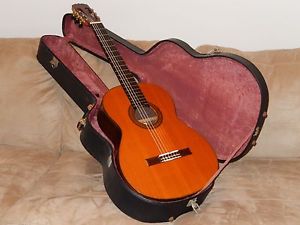
ULTRA RARE - MASARU MATANO CLASE 250 1969 - EXCEPTIONAL CLASSICAL CONCERT GUITAR
Estimated price for orientation: 1 200 $
Category: Classical Guitars
Class:
Description
Please read my 3 days return policy at the bottom of the page.If you'd like to see pictures of over 500 classical & flamenco guitars that I've sold in the past, please visit "Victor's Guitar Gallery" on Facebook Masaru Matano Classe 250 1969This particular guitar was made and signed by Masaru Matano in 1969. This guitar despite its age, remains in truly perfect working condition. It's top has few small dents and several very light surface scratches, but back & sides, neck and headstock remain in excellent+ cosmetic condition. The gorgeous sound and exceptional volume of this guitar makes it an equal challenger to many old Ramirez guitars. The major advantage of Matano guitar is that it is far easier to play than 99% of old Ramirez guitars. This guitar is also a great example to illustrate "Real Value of Japanese Made Guitars". This guitar was priced 25 000 yen in 1969, while yearly salary of Japanese college graduate was 34 200 yen. During that year many "all solid woods" Japanese made guitars were priced at similar level. YamahaGC3 & Hiroshi Tamura's P30 were priced 30 000 yen. Less known makers were selling their "all solid" models for 20 000 yen. Masaru Kohno top model was #10 (solid Spruce top/ solid Brazilian Rosewood b/s) priced 100 000. Yamaha's models GC5, GC7 & GC10 were all made with solid Brazilian Rosewood b/s. If you can find and take a look at this posting MADE IN 1970 ULTRA RARE MASARU MATANO C400 EXCEPTIONAL CLASSICAL CONCERT GUITAR (201750998743) you may realize how Japanese guitar making industry greatly changed over just one year. Simply saying: M.Matano model clase 400 from 1970 is much lower grade instrument if compared with M.Matano model clase 400 made in 1969. Model classe 250 from 1969 is equal grade guitar to model classe 400 from 1970.Even though yearly salary of Japanese college graduate jumped only from 34 200 yen in 1969 to 39 200 in 1970, real prices of guitars jumped much higher. By the end of 1970 some "all solid woods" Japanese made guitars were still priced at 30 000 yen level (YamahaGC3D) but they were no match to 30 000 yen guitars made in 1969. Many other 30 000 or 40 000 yen guitars were made with laminated b/s (M.Matano clase 300, clase 400, Hiroshi Tamura's P30, P40). By the end of 1970 Masaru Kohno top model was #15 (solid Brazilian Rosewood b/s) priced 150 000 yen, while his model #10 (100 000 yen) was made with "only" solid Indian Rosewood b/s. New Yamaha's lineup included models GC5, GC7 & GC10 (with solid Indian Rosewood b/s) and GC12 & GC15 (with solid Brazilian Rosewood b/s.) In early 1970s R.Matsuoka model M30 was sold in US for $600 . Therefore Matano's model Classe 250 would have to be priced at least $500, which had the same purchase power as $2500 today.Masaru Matano is remembered in Japan as "genius of the sound". Regardless of what materials he used, his guitars sounded far better than much higher priced guitars made by most famous luthiers of that era. On several occasions M. Matano was able to improve the sound of old Stradivarius violins. This guitar is a “perfect instrument”, a concert guitar, producing beautiful and well balanced notes, clear and ringing trebles, deep resonating basses, all at very high volume, with very impressive sustain. Guitar is very light, responsive to a lightest touch and with current action plays super easy.Although this particular guitar has Matano's unique headstock it is nothing but a great "copy" of Ramirez guitars. However this "copy" is simply much better sounding than many original Ramirez guitars that I had a chance to try in the past. In addition most of these old Ramirez guitars were almost impossible to play, while this Matano guitar plays like a butter.Masaru Matano was one of the best Japanese luthiers ever. He was the founder of modern ASTURIAS guitars workshop and its first Master Luthier. He was also a long-time friend and teammate with Shiro Arai and in early 1970s he co-founded ARIA guitars workshop in Nagoya, Japan. Masaru Matano’s philosophy has always been “quality first”. His guitars have always been highly regarded and sought by international players, despite their high prices.All M. Matano guitars even in 1970-ties were sold in Europe at quite high prices. They in fact opened the path to European markets for Aria and Asturias guitars. It is truly a great loss for American players that these brands have never been seriously distributed in North America. If they were, we wouldn’t have today that many low quality “hand made in Spain” guitars on US market. SPECIFICATIONS:Top: Very High Grade Solid Cedar/lacquerBack & sides: Indian Rosewood High Grade Laminates/lacquer Neck: MahoganyFingerboard: Striped Indian EbonyWith at the nut: 52 mmScale: 658 mmOriginal deffective tuners were replaced with new ones.Action is set to 3.5 mm under E6 and 3.00 mm under E1 with plenty of extra room on the saddle.This guitar will be shipped in used hard case in still good condition, although of minimal value. Here is some info you might be interested in:HISTORY OF ARIA"It all started with the classical guitar", says Shiro Arai, Chairman and the founder of Aria Guitars.One day, a friend came to visit Shiro's apartment with a guitar. Shiro was expecting to hear Koga-type Japanese popular music, but instead his friend started to play a piece by Bach. From this moment, he had been inspired by the sound of this instrument forever.The very next day, Shiro bought his first guitar, costing over two months salary and began to teach himself to play. Now playing day and night, his passion for the guitar brought him to a famous classical guitar master in Nagoya, and soon became one of his students.Shiro started work for a trading company in 1947, aged 17. In 1953, Shiro and two of his colleagues resigned their positions and founded their own trading firm. After the fledgling company failed after just one year Shiro found himself homeless with nothing but his guitar. In order to live and settle the outstanding debts from this first business he started to teach the guitar.In 1954 unable to buy guitars, music and strings in Japan's music stores, Shiro started to import classical guitars, Augustine guitar strings, and musical scores for himself and his students. These were the first classical guitars imported into post-war Japan and included instruments from renowned makers Jose Ramirez and Hermann Hauser. Recognising an increasing demand for guitars from friends and players throughout Japan, Shiro grasped the opportunity to start his own business. On August 2nd, 1956, ARAI & CO., INC was founded.At this time, although demand for classical guitars and accessories were increasing, it was still comparatively low and business was supplemented with other products including woollen material.The name, "ARIA", which means expressive melody, was first used in 1958 when Arai exported Japanese built classical guitars fitted with steel strings to South East Asia in 1963. Also the letters of his name "ARAI" were just switched around to "ARIA as he recalled.Shiro embarked on a tour of the US with two of the best Japanese KOHNO guitars. At that time Japanese guitars had a poor reputation for developing body cracks and warped necks after being exposed to drier conditions abroad. It was Shiro's intention to prove how good Japanese guitars were by performing and showing to fellow guitarists, teachers and music shops. After two months these guitars also started to crack.Even the best available Kohno guitars faced the same problem. Shiro took these cracked guitars back to Japan to show their makers just how vital it is to use properly seasoned tone woods. This trip gave Shiro the experience and knowledge to improve the quality of guitars and export Japanese guitars worldwide.It was as early as the late 50's when Arai started to import Fender guitars and amplifiers from the US, although at that time the Japanese market was not quite ready for the electric guitar! With the advent of rock n' roll demand for electric guitars took-off. Arai released its first ARIA brand electric guitars in 1963. Exporting to the US followed with models including the 1532T and 1802T.To counter the decline of the solid body electric guitar boom, Arai released the Aria Diamond series hollow body semi-acoustic guitars. Aria Diamond was named after the imitation diamond inlayed into the headstock. This series lead to the release of the 1202 and 1302 models in 1966 and caused nothing short of a sensation in Japan. From 1967 Aria added a variety of models including the solid body 1962T, R-320, and violin shaped 12-string and bass guitars, and a full acoustic guitar, the 1262.In 1975, Aria Pro II was developed from Aria's custom shop making high-end models for professional users. In 1976, Aria Pro II released its first original model, the PE-1500.PE (Prototype Line) is a classic Aria design, also known as the legendary masterpiece, it featured an arched top, and all maple carved body with Aria's original "heel-less neck and DiMarzio Super Distortion Humbucking Pickups. Primarily designed for tone and playability, the PE series has been modified to match today's trends while keeping its original features and timeless design.In 1978, Aria Pro II released another long-selling model, the SB-1000. The SB-1000 was highly regarded throughout the world and came to represent everything that was good about Aria and Japanese guitar building. Featuring a Canadian Ash body with neck through body and, to enhance playability, a heel-less neck. For its original tone, SB featured the Aria original BB circuit. Its exotic see-through finish and the eye position marks make the SB amongst the most distinctive basses ever made.Aria Pro II led the way with the 80's shift to Hard Rock and Heavy Metal. Releasing many models such as XX, ZZ and U-1. Whilst not abandoning their routes also re-established the semi-acoustic guitar models, FA and TA. The 80s, also saw the introduction of the famous IGB (SB INTEGRA) bass series.In the early 1990s, after the heavy metal rush, Aria Pro II released one of its favourite original models, the MA series to reinforce the PE and SB line-ups. MA series bodies are constructed with innovative crystal shaped carved top and back.Continuing its remarkable progress, Aria released the very unique concept of the SWB (electric upright bass) series to the world in 1992. The SWB range offers compact modern design and features the Fishman custom bridge Piezo pickup and active tone circuit.Aria has been at the forefront of guitar and Japanese guitar building excellence for 50 years, which means a wealth of experience and acquired expertise. The core value remains the same today, to constantly strive to achieve a higher level of excellence, quality and value for musicians. Member Join Date: Jan 2004 Location: Torrance Ca. Posts: 49
Back in 1983 I bought a Masaru Matano clase 400 guitar on the advice of my instructor. He had a friend that imported them and he thought they were a bargain at $475.(1983 price) That has been my primary guitar since then. I've had the opportunity to play many different guitars and I wouldn't trade my Matano for any of them. Recently I saw a Matano clase 500 model for sale on EBAY. I was the only bidder at $450 so I ended up with it. My clase 400 was made in 1981 and the clase 500 was made in 1977. The new (older) guitar obviously hadn't been played for years but it cleaned up beautifully. It has a really bright sound and IMHO is worth at least three to four times what I paid for it. The two guitars are ,as expected, very similar and I'm still trying to make up my mind which one I like better. The only obvious difference is that the 500 has a prettier bridge and what appears to be ebony re-enforcement in the neck.
The finger board on both is rosewood. Some people associate a rosewood fingerboard with an inferior instrument but I never believed that. A lot of what passes for ebony is dyed rosewood anyway. I believe that the Matano clase 600 has an ebony fingerboard and I'm on the lookout for one.
If a Matano has become available to you at a reasonable price I don't think you can go wrong.
Ed
by » Sunday 30 March 2008, 01:09 amDear Mr. Fritz Kadiddlehopper,Luthier Masaru Whooper,
Thanks for the information on Masaru Matano. I bought a Matano in 1980 from the US distributor JTG of Nashville, but sold it in 1983 after I got a luthier made guitar. I liked it very much, but had to pay for the other guitar. As far as I remember, my Matano cost around US$600. The person who bought it from me was a performer. About ten years later, I tried to buy it back, but he loved it so much he wouldn't part with it. When I sold mine, the prices of Matano guitars had almost doubled in price, due in part I guess to his having stopped making instruments.
It's a pity he left the industry, but the few people I knew who had his guitars appreciated them highly.It is too bad for you. Yes,
Description
Please read my 3 days return policy at the bottom of the page.If you'd like to see pictures of over 500 classical & flamenco guitars that I've sold in the past, please visit "Victor's Guitar Gallery" on Facebook Masaru Matano Classe 250 1969This particular guitar was made and signed by Masaru Matano in 1969. This guitar despite its age, remains in truly perfect working condition. It's top has few small dents and several very light surface scratches, but back & sides, neck and headstock remain in excellent+ cosmetic condition. The gorgeous sound and exceptional volume of this guitar makes it an equal challenger to many old Ramirez guitars. The major advantage of Matano guitar is that it is far easier to play than 99% of old Ramirez guitars. This guitar is also a great example to illustrate "Real Value of Japanese Made Guitars". This guitar was priced 25 000 yen in 1969, while yearly salary of Japanese college graduate was 34 200 yen. During that year many "all solid woods" Japanese made guitars were priced at similar level. YamahaGC3 & Hiroshi Tamura's P30 were priced 30 000 yen. Less known makers were selling their "all solid" models for 20 000 yen. Masaru Kohno top model was #10 (solid Spruce top/ solid Brazilian Rosewood b/s) priced 100 000. Yamaha's models GC5, GC7 & GC10 were all made with solid Brazilian Rosewood b/s. If you can find and take a look at this posting MADE IN 1970 ULTRA RARE MASARU MATANO C400 EXCEPTIONAL CLASSICAL CONCERT GUITAR (201750998743) you may realize how Japanese guitar making industry greatly changed over just one year. Simply saying: M.Matano model clase 400 from 1970 is much lower grade instrument if compared with M.Matano model clase 400 made in 1969. Model classe 250 from 1969 is equal grade guitar to model classe 400 from 1970.Even though yearly salary of Japanese college graduate jumped only from 34 200 yen in 1969 to 39 200 in 1970, real prices of guitars jumped much higher. By the end of 1970 some "all solid woods" Japanese made guitars were still priced at 30 000 yen level (YamahaGC3D) but they were no match to 30 000 yen guitars made in 1969. Many other 30 000 or 40 000 yen guitars were made with laminated b/s (M.Matano clase 300, clase 400, Hiroshi Tamura's P30, P40). By the end of 1970 Masaru Kohno top model was #15 (solid Brazilian Rosewood b/s) priced 150 000 yen, while his model #10 (100 000 yen) was made with "only" solid Indian Rosewood b/s. New Yamaha's lineup included models GC5, GC7 & GC10 (with solid Indian Rosewood b/s) and GC12 & GC15 (with solid Brazilian Rosewood b/s.) In early 1970s R.Matsuoka model M30 was sold in US for $600 . Therefore Matano's model Classe 250 would have to be priced at least $500, which had the same purchase power as $2500 today.Masaru Matano is remembered in Japan as "genius of the sound". Regardless of what materials he used, his guitars sounded far better than much higher priced guitars made by most famous luthiers of that era. On several occasions M. Matano was able to improve the sound of old Stradivarius violins. This guitar is a “perfect instrument”, a concert guitar, producing beautiful and well balanced notes, clear and ringing trebles, deep resonating basses, all at very high volume, with very impressive sustain. Guitar is very light, responsive to a lightest touch and with current action plays super easy.Although this particular guitar has Matano's unique headstock it is nothing but a great "copy" of Ramirez guitars. However this "copy" is simply much better sounding than many original Ramirez guitars that I had a chance to try in the past. In addition most of these old Ramirez guitars were almost impossible to play, while this Matano guitar plays like a butter.Masaru Matano was one of the best Japanese luthiers ever. He was the founder of modern ASTURIAS guitars workshop and its first Master Luthier. He was also a long-time friend and teammate with Shiro Arai and in early 1970s he co-founded ARIA guitars workshop in Nagoya, Japan. Masaru Matano’s philosophy has always been “quality first”. His guitars have always been highly regarded and sought by international players, despite their high prices.All M. Matano guitars even in 1970-ties were sold in Europe at quite high prices. They in fact opened the path to European markets for Aria and Asturias guitars. It is truly a great loss for American players that these brands have never been seriously distributed in North America. If they were, we wouldn’t have today that many low quality “hand made in Spain” guitars on US market. SPECIFICATIONS:Top: Very High Grade Solid Cedar/lacquerBack & sides: Indian Rosewood High Grade Laminates/lacquer Neck: MahoganyFingerboard: Striped Indian EbonyWith at the nut: 52 mmScale: 658 mmOriginal deffective tuners were replaced with new ones.Action is set to 3.5 mm under E6 and 3.00 mm under E1 with plenty of extra room on the saddle.This guitar will be shipped in used hard case in still good condition, although of minimal value. Here is some info you might be interested in:HISTORY OF ARIA"It all started with the classical guitar", says Shiro Arai, Chairman and the founder of Aria Guitars.One day, a friend came to visit Shiro's apartment with a guitar. Shiro was expecting to hear Koga-type Japanese popular music, but instead his friend started to play a piece by Bach. From this moment, he had been inspired by the sound of this instrument forever.The very next day, Shiro bought his first guitar, costing over two months salary and began to teach himself to play. Now playing day and night, his passion for the guitar brought him to a famous classical guitar master in Nagoya, and soon became one of his students.Shiro started work for a trading company in 1947, aged 17. In 1953, Shiro and two of his colleagues resigned their positions and founded their own trading firm. After the fledgling company failed after just one year Shiro found himself homeless with nothing but his guitar. In order to live and settle the outstanding debts from this first business he started to teach the guitar.In 1954 unable to buy guitars, music and strings in Japan's music stores, Shiro started to import classical guitars, Augustine guitar strings, and musical scores for himself and his students. These were the first classical guitars imported into post-war Japan and included instruments from renowned makers Jose Ramirez and Hermann Hauser. Recognising an increasing demand for guitars from friends and players throughout Japan, Shiro grasped the opportunity to start his own business. On August 2nd, 1956, ARAI & CO., INC was founded.At this time, although demand for classical guitars and accessories were increasing, it was still comparatively low and business was supplemented with other products including woollen material.The name, "ARIA", which means expressive melody, was first used in 1958 when Arai exported Japanese built classical guitars fitted with steel strings to South East Asia in 1963. Also the letters of his name "ARAI" were just switched around to "ARIA as he recalled.Shiro embarked on a tour of the US with two of the best Japanese KOHNO guitars. At that time Japanese guitars had a poor reputation for developing body cracks and warped necks after being exposed to drier conditions abroad. It was Shiro's intention to prove how good Japanese guitars were by performing and showing to fellow guitarists, teachers and music shops. After two months these guitars also started to crack.Even the best available Kohno guitars faced the same problem. Shiro took these cracked guitars back to Japan to show their makers just how vital it is to use properly seasoned tone woods. This trip gave Shiro the experience and knowledge to improve the quality of guitars and export Japanese guitars worldwide.It was as early as the late 50's when Arai started to import Fender guitars and amplifiers from the US, although at that time the Japanese market was not quite ready for the electric guitar! With the advent of rock n' roll demand for electric guitars took-off. Arai released its first ARIA brand electric guitars in 1963. Exporting to the US followed with models including the 1532T and 1802T.To counter the decline of the solid body electric guitar boom, Arai released the Aria Diamond series hollow body semi-acoustic guitars. Aria Diamond was named after the imitation diamond inlayed into the headstock. This series lead to the release of the 1202 and 1302 models in 1966 and caused nothing short of a sensation in Japan. From 1967 Aria added a variety of models including the solid body 1962T, R-320, and violin shaped 12-string and bass guitars, and a full acoustic guitar, the 1262.In 1975, Aria Pro II was developed from Aria's custom shop making high-end models for professional users. In 1976, Aria Pro II released its first original model, the PE-1500.PE (Prototype Line) is a classic Aria design, also known as the legendary masterpiece, it featured an arched top, and all maple carved body with Aria's original "heel-less neck and DiMarzio Super Distortion Humbucking Pickups. Primarily designed for tone and playability, the PE series has been modified to match today's trends while keeping its original features and timeless design.In 1978, Aria Pro II released another long-selling model, the SB-1000. The SB-1000 was highly regarded throughout the world and came to represent everything that was good about Aria and Japanese guitar building. Featuring a Canadian Ash body with neck through body and, to enhance playability, a heel-less neck. For its original tone, SB featured the Aria original BB circuit. Its exotic see-through finish and the eye position marks make the SB amongst the most distinctive basses ever made.Aria Pro II led the way with the 80's shift to Hard Rock and Heavy Metal. Releasing many models such as XX, ZZ and U-1. Whilst not abandoning their routes also re-established the semi-acoustic guitar models, FA and TA. The 80s, also saw the introduction of the famous IGB (SB INTEGRA) bass series.In the early 1990s, after the heavy metal rush, Aria Pro II released one of its favourite original models, the MA series to reinforce the PE and SB line-ups. MA series bodies are constructed with innovative crystal shaped carved top and back.Continuing its remarkable progress, Aria released the very unique concept of the SWB (electric upright bass) series to the world in 1992. The SWB range offers compact modern design and features the Fishman custom bridge Piezo pickup and active tone circuit.Aria has been at the forefront of guitar and Japanese guitar building excellence for 50 years, which means a wealth of experience and acquired expertise. The core value remains the same today, to constantly strive to achieve a higher level of excellence, quality and value for musicians.
by » Sunday 30 March 2008, 01:09 amDear Mr. Fritz Kadiddlehopper,Luthier Masaru
Whooper,
| |||
| Back in 1983 I bought a Masaru Matano clase 400 guitar on the advice of my instructor. He had a friend that imported them and he thought they were a bargain at $475.(1983 price) That has been my primary guitar since then. I've had the opportunity to play many different guitars and I wouldn't trade my Matano for any of them. Recently I saw a Matano clase 500 model for sale on EBAY. I was the only bidder at $450 so I ended up with it. My clase 400 was made in 1981 and the clase 500 was made in 1977. The new (older) guitar obviously hadn't been played for years but it cleaned up beautifully. It has a really bright sound and IMHO is worth at least three to four times what I paid for it. The two guitars are ,as expected, very similar and I'm still trying to make up my mind which one I like better. The only obvious difference is that the 500 has a prettier bridge and what appears to be ebony re-enforcement in the neck. The finger board on both is rosewood. Some people associate a rosewood fingerboard with an inferior instrument but I never believed that. A lot of what passes for ebony is dyed rosewood anyway. I believe that the Matano clase 600 has an ebony fingerboard and I'm on the lookout for one. If a Matano has become available to you at a reasonable price I don't think you can go wrong. Ed | |||
Thanks for the information on Masaru Matano. I bought a Matano in 1980 from the US distributor JTG of Nashville, but sold it in 1983 after I got a luthier made guitar. I liked it very much, but had to pay for the other guitar. As far as I remember, my Matano cost around US$600. The person who bought it from me was a performer. About ten years later, I tried to buy it back, but he loved it so much he wouldn't part with it. When I sold mine, the prices of Matano guitars had almost doubled in price, due in part I guess to his having stopped making instruments.
It's a pity he left the industry, but the few people I knew who had his guitars appreciated them highly.It is too bad for you. Yes,