Back to the main page Back to category Vintage Pro Audio Equipment
musical instrument details
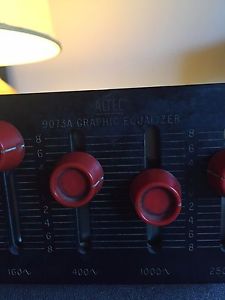
Altec 9073a Passive Equalizer - Vintage Rare 1960's 6-Band Motown EQ
Estimated price for orientation: 1 000 $
Category: Vintage Pro Audio Equipment
Class:
Description Type: Vintage Equalizer
For sale is an extremely rare, vintage (1960’s) Altec 9073a 6-Band Passive EQ. Similar to the famous 9062, the Pultec EQ and the related Langevin EQ, these units are renowned for their warmth, particularly in boosting low / mid frequencies. Given its age, the unit is in pretty good condition. All the arms move up and down, although one does not travel all the way up to the top, stopping just shy. Tested an audio signal through it - 3 of the frequency bands affect the signal as they should, while 3 have no affect. This thing probably needs to be recapped, given its age, and given that half the channels still work, I think this would probably be a quick repair job. Selling AS-IS, no returns. Item will be well packed for transport, but this thing is built like a brick and is probably indestructible. Own a piece of music history!The Altec 9073 is an great example of how much things have changed when it comes to materials and build quality. The EQ modules appear to be the same as the ones used in the Altec model 9062A, the famous “Motown EQ”Here are a few details on this Altec Passive EQ:• Gold traces throughout, wider and thicker than current standards• Gold eyelets in all PCBs• PCBs are glass epoxy, not phenolic • .25" thick Aluminum side and front plates• Pivoting Wiper arm with redundant gold spring contacts• Mylar caps throughout• Air core coils throughoutThe Atlec 9073A is a passive EQ with center frequencies at:• 64 HZ• 160 HZ• 400 HZ• 1 KHZ• 2.5 KHZ• 6.3 KHZIt provides a center detent with a range of +8 db at each frequency.Additional information on this piece is scarce and some of the sources may be unverified. With that in mind here is a selection of comments we've found in our searches. The Altec 9062A and Langevin 252A are both bridged-T constant impedance passive circuits. I've attached a diagram of the basic Constant-B implementation (see H. R. Kimball's "Motion Picture Sound Engineering" from 1938). X1 and X2 are the reactive elements—series and parallel LC pairs (inductors and capacitors). For a single band of boost and cut, you need a 4 pole 17 step (±8db in 1db steps plus flat) switch for the eq steps, plus additional switching to flip the LC pairs between boost and cut mode (Solomon and Broneer's Constant-S version cut down the attenuators needed from 4 to 3). This is a massive (expensive) and complex switch. See the picture of the guts of a single band from my Altec 9062A to get an idea of what's involved—the pcb/wiper construction was also how Altec/Langevin built their step attenuator faders and pan pot sliders. In both Altec and Langevin products from this era, the boards are etched glass epoxy with gold plated traces. The wipers are bifurcated (redundant contacts). I have never seen one of these boards with corroded traces.The 6-band Altec was designated for "motion picture recording and dialogue" while the 7-band (was) for "music recording." The frequency bands of the 9073 are almost identical to the Cinema Engineering 7080 despite differences in implementation: 64, 160, 400, 1000, 2500, 6300hz. The only discrepancy is the Cinema's first band, which is 63hz.
Description
| Type: | Vintage Equalizer |
For sale is an extremely rare, vintage (1960’s) Altec 9073a 6-Band Passive EQ. Similar to the famous 9062, the Pultec EQ and the related Langevin EQ, these units are renowned for their warmth, particularly in boosting low / mid frequencies. Given its age, the unit is in pretty good condition. All the arms move up and down, although one does not travel all the way up to the top, stopping just shy. Tested an audio signal through it - 3 of the frequency bands affect the signal as they should, while 3 have no affect. This thing probably needs to be recapped, given its age, and given that half the channels still work, I think this would probably be a quick repair job. Selling AS-IS, no returns. Item will be well packed for transport, but this thing is built like a brick and is probably indestructible. Own a piece of music history!The Altec 9073 is an great example of how much things have changed when it comes to materials and build quality. The EQ modules appear to be the same as the ones used in the Altec model 9062A, the famous “Motown EQ”Here are a few details on this Altec Passive EQ:• Gold traces throughout, wider and thicker than current standards• Gold eyelets in all PCBs• PCBs are glass epoxy, not phenolic • .25" thick Aluminum side and front plates• Pivoting Wiper arm with redundant gold spring contacts• Mylar caps throughout• Air core coils throughoutThe Atlec 9073A is a passive EQ with center frequencies at:• 64 HZ• 160 HZ• 400 HZ• 1 KHZ• 2.5 KHZ• 6.3 KHZIt provides a center detent with a range of +8 db at each frequency.Additional information on this piece is scarce and some of the sources may be unverified. With that in mind here is a selection of comments we've found in our searches. The Altec 9062A and Langevin 252A are both bridged-T constant impedance passive circuits. I've attached a diagram of the basic Constant-B implementation (see H. R. Kimball's "Motion Picture Sound Engineering" from 1938). X1 and X2 are the reactive elements—series and parallel LC pairs (inductors and capacitors). For a single band of boost and cut, you need a 4 pole 17 step (±8db in 1db steps plus flat) switch for the eq steps, plus additional switching to flip the LC pairs between boost and cut mode (Solomon and Broneer's Constant-S version cut down the attenuators needed from 4 to 3). This is a massive (expensive) and complex switch. See the picture of the guts of a single band from my Altec 9062A to get an idea of what's involved—the pcb/wiper construction was also how Altec/Langevin built their step attenuator faders and pan pot sliders. In both Altec and Langevin products from this era, the boards are etched glass epoxy with gold plated traces. The wipers are bifurcated (redundant contacts). I have never seen one of these boards with corroded traces.The 6-band Altec was designated for "motion picture recording and dialogue" while the 7-band (was) for "music recording." The frequency bands of the 9073 are almost identical to the Cinema Engineering 7080 despite differences in implementation: 64, 160, 400, 1000, 2500, 6300hz. The only discrepancy is the Cinema's first band, which is 63hz.