Back to the main page Back to category Classical Guitars
musical instrument details
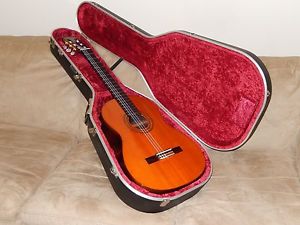
SUPER RARE HIROSHI TAMURA P50 1969 CLASSICAL GUITAR IN EXCELLENT+ CONDITION
Estimated price for orientation: 3 000 $
Category: Classical Guitars
Class:
Description Brand: Hiroshi Tamura Country/Region of Manufacture: Japan
Please read my 7 days return policy at the bottom of the page.*************************************************************************If you are thinking about a purchase of a used vintage guitar you need to accept the fact that such guitars may have cosmetic flaws solely associated with their age, but not related to any particular damage. For example their finishes change their look over the years and are not glossy and cristal clear like on brand new guitar. I see guitars as musical instruments, not a furniture. When I describe guitar as being in excellent condtion I don't talk only about its cosmetics but mostly about its structural & functional condition, sound and playbility. If you are seeking a perfect looking guitar you should abandon a thought about buying a used vintage one, especially from me. *******************************************************************************************If you’d like to own equal quality instrument available at lower price take a look at El Vito Concert R guitars postings. 1969 HIROSHI TAMURA P50 This guitar was made in 1969 by Hiroshi Tamura, one of the best luthiers in Japanese history. Some experts say that he was actually the best Japanese luthier, who had collected many international awards for his works, even more than great Masaru Kohno.This is a very high grade instrument, way better that many quite expensive guitars that you might have encountered in the past and considered as great. This guitar produces very characteristic to all Hiroshi Tamura guitars, truly Spanish, gentle and very seducing sound. Guitar is very responsive. Trebles are sweet and clear, basses vibrant and colorful. All well balanced, at very good volume with great sustain. You will have a hard time to put it down. This guitar has very little in common with model P50 distributed in US in mid 1970’s. In 1969 it was priced 50 000 yen, while average yearly salary of a Japanese college graduate was 34,600 yen. This salary in 1970 was 40000, but in 1975 it was 80 000. Exactly the same quality guitar by 1970 would labelled at least P65, by 1971 as P80, by 1973 as P100.This guitar, just like Yamaha model GC5 (made during years1967-1970) and other 50 000 yen guitars made by many other luthiers, was built with solid Brazilian Rosewood b/s. At that time only Masaru Kohno was able to sell his model 5 with "only" Indian Rosewood b/s. Most Hiroshi Tamura P series guitars distributed in US in 1970’s have developed a network of internal wrinkles within the finish. They often break at the very top and create a network of hair-like fissures. It must have been caused by light induced chemical degradation of at least one of the ingredients of the original lacquer. This guitar is an exception to this rule and its finish remains in super excellent condition for the age of a guitar. At very close inspection, on the sound board one can find few very small & shallow indentations within the finish and some very fine scratches. On the back there is just couple of very small dents. All of these mentioned above cosmetic imperfections are so minor that they hardly visible in nature and almost impossible to photograph. The most conspicuous cosmetic flaw is a tiny dent on the back of the very tip of a headstock.Very likely tuners, saddle and nut on this guitar have been replaced by the previous owner. They simply look brand new. In addition this guitar was refretted in January 2016 by Greg Hails, owner of "Aperio Guitar" LLC.Specifications:Top: High Grade Solid Spruce Top / finish Cashew LacquerBack and Sides: Solid Straight Grain Brazilian Rosewood / finish Cashew LacquerNeck: MahoganyFingerboard: EbonyNut and Saddle: BoneNut Width: 52 mmScale: 662 mmAction is set to 3.50 mm under E6 and 2.80 mm under E1, with extra room for experiments with lower action.This guitar will be shipped in lightly used HISCOX Hard Shell Case.In order to ship a package with guitar to Australia at affordable rate +/- $150.00 (USPS International Priority Mail), length of such package can’t exceed 42” and its girth (2 x times width + 2 x height) + length can’t exceed total of 97”. If you want original or non-original hard shell case, the size of the package will qualify it only for USPS/Fedex Global Express Guaranteed at $400.00 price. Real Value of Japanese Vintage GuitarsThe key to understand value of vintage Japanese guitars is to acknowledge galloping devaluation of Japanese yen in 1960s & 1970s. This devaluation was somewhat slower in 1980s. The best measure of this devaluation is Starting Yearly Salary of Japanese College Graduate (SYSJCG).SYSJCG in in 1965 was 19 600 yen, in 1969 – 34 600 yen, in 1970 39 200 yen, in 1972 – 62 300 yen, in 1975 79 200 yen, in 1977 121 200 yen and in 1980 - 163 000 yen.During 1960s and most of 1970s model numbers of Japanese guitars were strictly interconnected with their prices in Japanese yen. In late 1970s and during following decades model numbers were no longer strictly associated with their prices. Many Japanese guitar makers introduced model names instead of model numbers. Others were still using model numbers with addition of letter abbreviations or other symbols. The best and only logical approach while evaluating real value (real grade) of v
Description
| Brand: | Hiroshi Tamura | Country/Region of Manufacture: | Japan |
Please read my 7 days return policy at the bottom of the page.*************************************************************************If you are thinking about a purchase of a used vintage guitar you need to accept the fact that such guitars may have cosmetic flaws solely associated with their age, but not related to any particular damage. For example their finishes change their look over the years and are not glossy and cristal clear like on brand new guitar. I see guitars as musical instruments, not a furniture. When I describe guitar as being in excellent condtion I don't talk only about its cosmetics but mostly about its structural & functional condition, sound and playbility. If you are seeking a perfect looking guitar you should abandon a thought about buying a used vintage one, especially from me. *******************************************************************************************If you’d like to own equal quality instrument available at lower price take a look at El Vito Concert R guitars postings. 1969 HIROSHI TAMURA P50 This guitar was made in 1969 by Hiroshi Tamura, one of the best luthiers in Japanese history. Some experts say that he was actually the best Japanese luthier, who had collected many international awards for his works, even more than great Masaru Kohno.This is a very high grade instrument, way better that many quite expensive guitars that you might have encountered in the past and considered as great. This guitar produces very characteristic to all Hiroshi Tamura guitars, truly Spanish, gentle and very seducing sound. Guitar is very responsive. Trebles are sweet and clear, basses vibrant and colorful. All well balanced, at very good volume with great sustain. You will have a hard time to put it down. This guitar has very little in common with model P50 distributed in US in mid 1970’s. In 1969 it was priced 50 000 yen, while average yearly salary of a Japanese college graduate was 34,600 yen. This salary in 1970 was 40000, but in 1975 it was 80 000. Exactly the same quality guitar by 1970 would labelled at least P65, by 1971 as P80, by 1973 as P100.This guitar, just like Yamaha model GC5 (made during years1967-1970) and other 50 000 yen guitars made by many other luthiers, was built with solid Brazilian Rosewood b/s. At that time only Masaru Kohno was able to sell his model 5 with "only" Indian Rosewood b/s. Most Hiroshi Tamura P series guitars distributed in US in 1970’s have developed a network of internal wrinkles within the finish. They often break at the very top and create a network of hair-like fissures. It must have been caused by light induced chemical degradation of at least one of the ingredients of the original lacquer. This guitar is an exception to this rule and its finish remains in super excellent condition for the age of a guitar. At very close inspection, on the sound board one can find few very small & shallow indentations within the finish and some very fine scratches. On the back there is just couple of very small dents. All of these mentioned above cosmetic imperfections are so minor that they hardly visible in nature and almost impossible to photograph. The most conspicuous cosmetic flaw is a tiny dent on the back of the very tip of a headstock.Very likely tuners, saddle and nut on this guitar have been replaced by the previous owner. They simply look brand new. In addition this guitar was refretted in January 2016 by Greg Hails, owner of "Aperio Guitar" LLC.Specifications:Top: High Grade Solid Spruce Top / finish Cashew LacquerBack and Sides: Solid Straight Grain Brazilian Rosewood / finish Cashew LacquerNeck: MahoganyFingerboard: EbonyNut and Saddle: BoneNut Width: 52 mmScale: 662 mmAction is set to 3.50 mm under E6 and 2.80 mm under E1, with extra room for experiments with lower action.This guitar will be shipped in lightly used HISCOX Hard Shell Case.In order to ship a package with guitar to Australia at affordable rate +/- $150.00 (USPS International Priority Mail), length of such package can’t exceed 42” and its girth (2 x times width + 2 x height) + length can’t exceed total of 97”. If you want original or non-original hard shell case, the size of the package will qualify it only for USPS/Fedex Global Express Guaranteed at $400.00 price. Real Value of Japanese Vintage GuitarsThe key to understand value of vintage Japanese guitars is to acknowledge galloping devaluation of Japanese yen in 1960s & 1970s. This devaluation was somewhat slower in 1980s. The best measure of this devaluation is Starting Yearly Salary of Japanese College Graduate (SYSJCG).SYSJCG in in 1965 was 19 600 yen, in 1969 – 34 600 yen, in 1970 39 200 yen, in 1972 – 62 300 yen, in 1975 79 200 yen, in 1977 121 200 yen and in 1980 - 163 000 yen.During 1960s and most of 1970s model numbers of Japanese guitars were strictly interconnected with their prices in Japanese yen. In late 1970s and during following decades model numbers were no longer strictly associated with their prices. Many Japanese guitar makers introduced model names instead of model numbers. Others were still using model numbers with addition of letter abbreviations or other symbols. The best and only logical approach while evaluating real value (real grade) of v