Back to the main page Back to category Baritones
musical instrument details
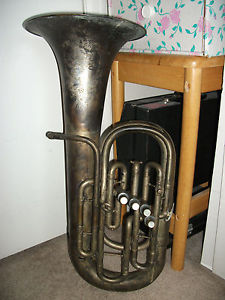
HARRY B JAY Bb baritone horn / euphonium w/ 4-valves! Plays Great! Good valves!
Estimated price for orientation: 599 $
Category: Baritones
Class:
Description Brand: HAIRY B JAY Skill Level: Professional Finish: Silver-Plated Model: Columbia Bell Material: Brass Country/Region of Manufacture: United States
Professional Bb professional baritone horn by Harry BJ, Columbia model.
(This was actually a respectable model name at the time, up until the 1950s, when pilots created a new meaning for it)To date it, the 1920 Jay catalog lists this exact horn. ready to play, accepts a medium shank (euro-shank) mouthpiece like a 51D for the original Willson 2900. Most tenor-shank trombone mouthpieces still fit, but go in almost all the way.Currently configured for modern pitch (A440) so you can successfully play it with other instruments. In the Jay Catalog from 1920 it says "Designed in low pitch with tuning slide and extra valve slides for high pitch." Since A440 is between the two pitch standards (435 - 452Hz), it plays usably in tune when you pull the main slide 1.5", #1 out 3/4", and #3 out 1" (for summer temps), and is further adjustable if needed.Louis Armstrong's first decent horn was a Harry B Jay trumpet, on which he had [arguably] his best sound. Some historians speculate it was his sound on the Harry B Jay that hastened the demise of the cornet. It is in the Smithsonian Institute Museum on display.....Condition:
Heavily tarnished, small dents throughout, visible repairs. Horn has a strong sound, All slides are free and valves move smoothly.
Description
| Brand: | HAIRY B JAY | Skill Level: | Professional |
| Finish: | Silver-Plated | Model: | Columbia |
| Bell Material: | Brass | Country/Region of Manufacture: | United States |
Professional Bb professional baritone horn by Harry BJ, Columbia model.
(This was actually a respectable model name at the time, up until the 1950s, when pilots created a new meaning for it)To date it, the 1920 Jay catalog lists this exact horn. ready to play, accepts a medium shank (euro-shank) mouthpiece like a 51D for the original Willson 2900. Most tenor-shank trombone mouthpieces still fit, but go in almost all the way.Currently configured for modern pitch (A440) so you can successfully play it with other instruments. In the Jay Catalog from 1920 it says "Designed in low pitch with tuning slide and extra valve slides for high pitch." Since A440 is between the two pitch standards (435 - 452Hz), it plays usably in tune when you pull the main slide 1.5", #1 out 3/4", and #3 out 1" (for summer temps), and is further adjustable if needed.Louis Armstrong's first decent horn was a Harry B Jay trumpet, on which he had [arguably] his best sound. Some historians speculate it was his sound on the Harry B Jay that hastened the demise of the cornet. It is in the Smithsonian Institute Museum on display.....Condition:
Heavily tarnished, small dents throughout, visible repairs. Horn has a strong sound, All slides are free and valves move smoothly.
(This was actually a respectable model name at the time, up until the 1950s, when pilots created a new meaning for it)To date it, the 1920 Jay catalog lists this exact horn. ready to play, accepts a medium shank (euro-shank) mouthpiece like a 51D for the original Willson 2900. Most tenor-shank trombone mouthpieces still fit, but go in almost all the way.Currently configured for modern pitch (A440) so you can successfully play it with other instruments. In the Jay Catalog from 1920 it says "Designed in low pitch with tuning slide and extra valve slides for high pitch." Since A440 is between the two pitch standards (435 - 452Hz), it plays usably in tune when you pull the main slide 1.5", #1 out 3/4", and #3 out 1" (for summer temps), and is further adjustable if needed.Louis Armstrong's first decent horn was a Harry B Jay trumpet, on which he had [arguably] his best sound. Some historians speculate it was his sound on the Harry B Jay that hastened the demise of the cornet. It is in the Smithsonian Institute Museum on display.....Condition:
Heavily tarnished, small dents throughout, visible repairs. Horn has a strong sound, All slides are free and valves move smoothly.