Back to the main page Back to category Classical Guitars
musical instrument details
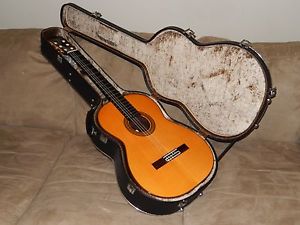
VINTAGE ASTURIAS JOHN MILLS #15 (CUSTOM) CLASSICAL GUITAR IN EXCELLENT CONDITION
Estimated price for orientation: 1 500 $
Category: Classical Guitars
Class:
Description Brand: Asturias Country/Region of Manufacture: Japan
Please read my 7 days return policy at the bottom of the page.*************************************************************************If you are thinking about a purchase of a used vintage guitar you need to accept the fact that such guitars may have cosmetic flaws solely associated with their age, but not related to any particular damage. For example their finishes change their look over the years and are not glossy and crystal clear like on brand new guitar. In addition, such guitars may require fret dressing, new tuners, string action adjustment or a simple repair before they can be fully enjoyed. I see guitars as musical instruments, not as furniture. When I describe guitar as being in excellent condition I don't talk only about its cosmetics but mostly about its structural & functional condition, sound and playability. If you are seeking a perfect looking, low maintenance guitar you should abandon a thought about buying used vintage one, especially from me.******************************************************************************************* Asturias John Mills #15 (Custom S) Model MJ15 has later on been re-named to model “Custom”. This guitar is much louder and more responsive than other higher Asturias models made in later decades, especially after year 2000.Currently Asturias classical & flamenco guitar lineup begins with model Prelude priced 214 000 yen. Model Prelude since year 2015 is made with high grade laminates for b/s instead of solid b/s. The least expensive “all solid woods” Asturias guitar currently available on US market is model Asturias Comfort (630 mm scale) sold by Guitar Salon International for $3500. Price for this model in Japan is 240 000 yen. Model Custom is priced 270 000, while model Renaissance is priced 324 000 yen. You can calculate yourself their US retail prices.As the serial number (00677) indicates, this guitar was made in 1981. It survived in truly excellent working condition for its age. It has however few cosmetic flaws.Unfortunately during the storage a crack in the finish (not within the wood) has developed above the fingerboard. This crack is not result of any impact, but occurred due to a difference in microclimates this guitar has been stored earlier for years and now. Due to a change in humidity the wood of soundboard expanded and revealed crack along the already predisposed weaker spot.This crack has been sealed (see picture 04) and re-polished. Such repair only takes care of the crack itself, but leaving a “scar” is unavoidable . Despite my expectations, similar crack on the other side of the fingerboard never happened (see picture 5). These cosmetic flaws don’t affect the structure, sound or playability of a guitar. It is rather difficult to have them completely removed, without a major re-finish of the sound board. It is true high grade concert guitar with impressive volume and colorful, sweet tone, resonance and sustain. Asturias guitars were highly sought by European players, since their debut on European markets in early 1980’s.Asturias guitars, despite strong competition with Spanish made guitars, were sold in Europe at really high prices. The reason is that they simply represented far more value than similarly priced guitars made by other makers. In fact Asturias guitars sound more “Spanish” than many Spanish made guitars.Its price was 150 000 yen in 1980, a value equal to 7/8 of yearly salary of Japanese college graduate. Masaru Kohno model 15 was priced the same 150 000. Kohno's model 15 in 1984 was renamed to Professional R and priced 200 000 yen. Asturias JM15 was relabeled to Asturias Custom and also priced 200 000 yen. If this guitar was offered for sale in USA in 1980 it had be priced at least $1,500. A purchase power of $1000 in 1980 equals to a purchase power of $3000 today.Asturias has a great reputation for tone and built quality. They are made at small workshop that employs about 15 craftsmen, in Kurume, Japan. Asturias began making guitars in 1962, and their production of classical guitars has always been in limited numbers. However the labels with the name Asturias appeared for the first time in 1980. Initially these labels had no serial numbers on them. Serial numbers were introduced in 1981 and only since that time we can easily date these guitars.Prior to 1980 this Kurume workshop belonged to Masaru Matano and his “Meiko Gakki” co. One of his known associates was Hiromi Yamaguchi, who since early 1970’ was the maker of “Cervantes” guitars. After Hiromi Yamaguchi joined Asturias team for good, “Cervantes“ guitars were still being made along other Asturias labeled guitars at least until 1982. At some point in time, Hiromi Yamaguchi left Asturias and started making guitars under his own name.Another Matano’s associate was highly regarded luthier Eichi Kodaira, who within the Asturias team was responsible for making all AST models. At some point in time, Eichi and a group of his closest associates moved to another workshop located in Suwa (Nagano Prefecture) and started making Asturias Kodaira guitars, identical with AST models earlier made at Kurume workshop.Both workshops were working for the same trading company Rokkoman Inc. (first of all a serious Japanese lumber importer).Sometime in 1981 Masaru Matano had left the team, which stayed at his Kurume shop. Details of Ma
Description
| Brand: | Asturias | Country/Region of Manufacture: | Japan |
Please read my 7 days return policy at the bottom of the page.*************************************************************************If you are thinking about a purchase of a used vintage guitar you need to accept the fact that such guitars may have cosmetic flaws solely associated with their age, but not related to any particular damage. For example their finishes change their look over the years and are not glossy and crystal clear like on brand new guitar. In addition, such guitars may require fret dressing, new tuners, string action adjustment or a simple repair before they can be fully enjoyed. I see guitars as musical instruments, not as furniture. When I describe guitar as being in excellent condition I don't talk only about its cosmetics but mostly about its structural & functional condition, sound and playability. If you are seeking a perfect looking, low maintenance guitar you should abandon a thought about buying used vintage one, especially from me.******************************************************************************************* Asturias John Mills #15 (Custom S) Model MJ15 has later on been re-named to model “Custom”. This guitar is much louder and more responsive than other higher Asturias models made in later decades, especially after year 2000.Currently Asturias classical & flamenco guitar lineup begins with model Prelude priced 214 000 yen. Model Prelude since year 2015 is made with high grade laminates for b/s instead of solid b/s. The least expensive “all solid woods” Asturias guitar currently available on US market is model Asturias Comfort (630 mm scale) sold by Guitar Salon International for $3500. Price for this model in Japan is 240 000 yen. Model Custom is priced 270 000, while model Renaissance is priced 324 000 yen. You can calculate yourself their US retail prices.As the serial number (00677) indicates, this guitar was made in 1981. It survived in truly excellent working condition for its age. It has however few cosmetic flaws.Unfortunately during the storage a crack in the finish (not within the wood) has developed above the fingerboard. This crack is not result of any impact, but occurred due to a difference in microclimates this guitar has been stored earlier for years and now. Due to a change in humidity the wood of soundboard expanded and revealed crack along the already predisposed weaker spot.This crack has been sealed (see picture 04) and re-polished. Such repair only takes care of the crack itself, but leaving a “scar” is unavoidable . Despite my expectations, similar crack on the other side of the fingerboard never happened (see picture 5). These cosmetic flaws don’t affect the structure, sound or playability of a guitar. It is rather difficult to have them completely removed, without a major re-finish of the sound board. It is true high grade concert guitar with impressive volume and colorful, sweet tone, resonance and sustain. Asturias guitars were highly sought by European players, since their debut on European markets in early 1980’s.Asturias guitars, despite strong competition with Spanish made guitars, were sold in Europe at really high prices. The reason is that they simply represented far more value than similarly priced guitars made by other makers. In fact Asturias guitars sound more “Spanish” than many Spanish made guitars.Its price was 150 000 yen in 1980, a value equal to 7/8 of yearly salary of Japanese college graduate. Masaru Kohno model 15 was priced the same 150 000. Kohno's model 15 in 1984 was renamed to Professional R and priced 200 000 yen. Asturias JM15 was relabeled to Asturias Custom and also priced 200 000 yen. If this guitar was offered for sale in USA in 1980 it had be priced at least $1,500. A purchase power of $1000 in 1980 equals to a purchase power of $3000 today.Asturias has a great reputation for tone and built quality. They are made at small workshop that employs about 15 craftsmen, in Kurume, Japan. Asturias began making guitars in 1962, and their production of classical guitars has always been in limited numbers. However the labels with the name Asturias appeared for the first time in 1980. Initially these labels had no serial numbers on them. Serial numbers were introduced in 1981 and only since that time we can easily date these guitars.Prior to 1980 this Kurume workshop belonged to Masaru Matano and his “Meiko Gakki” co. One of his known associates was Hiromi Yamaguchi, who since early 1970’ was the maker of “Cervantes” guitars. After Hiromi Yamaguchi joined Asturias team for good, “Cervantes“ guitars were still being made along other Asturias labeled guitars at least until 1982. At some point in time, Hiromi Yamaguchi left Asturias and started making guitars under his own name.Another Matano’s associate was highly regarded luthier Eichi Kodaira, who within the Asturias team was responsible for making all AST models. At some point in time, Eichi and a group of his closest associates moved to another workshop located in Suwa (Nagano Prefecture) and started making Asturias Kodaira guitars, identical with AST models earlier made at Kurume workshop.Both workshops were working for the same trading company Rokkoman Inc. (first of all a serious Japanese lumber importer).Sometime in 1981 Masaru Matano had left the team, which stayed at his Kurume shop. Details of Ma