Back to the main page Back to category Violas
musical instrument details
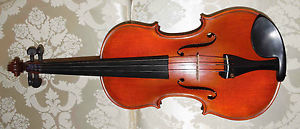
Viola, 14" Left Handed, Rare!!! *Unused*
Estimated price for orientation: 1 449 $
Category: Violas
Class:
Description Brand: Glaesel Type: Left Handed Model: Vasile Country/Region of Manufacture: Germany
Our nonprofit offers you a mint condition, unused, Left Handed Viola, 14". We have talked with Left handed violists who were forced to play with the right hand, and they suffered. Even people in symphonies play left handed, so set your style free! 14” Left handed German viola, +bow, +case. Unused, no nicks, dings or scrapes. Somehow, someone decided to turn a left handed viola into a right handed one, and the strings are in backward order and one is missing. We ordered high quality strings and installed them, and new pictures will be along shortly.Baroque style tuning pegs made of ebony. Solid one piece back. Guarneri style, however all amateurs will say this is Stradivarius style. Made on 7/9/12, aged perfectly for richer sound. When you buy an aged instrument, you know it won't crack or have an undesirable sound. Violas become more valuable with age if they are a quality instrument like this one. True double purfelling for added strength.Tight old growth stable grain through out: front, back, sides, neck and scroll! Usually these instruments have very wide grain which means cheap young fast grown wood is used in their construction. A quality instrument has the growth lines very tight to each other so you know the tree grew slowly to make dense, strong wood, which produces a more powerful resonant sound, with greater projection.Left handed instruments have a reverse finger board, and other features, they are not interchangeable with a right handed instrument. Since these are special order and custom made, greater care is taken with a left handed instrument than a right handed one. A must for the left handed musician, reduces muscle stress, improves musical qualities. If your teacher is telling you as a left handed person to use a right handed instrument and learn that way, they are completely wrong from an ethical viewpoint, a biomechanical viewpoint and a neurological viewpoint, and they are simply trying to make you have the homogenous orchestra image which is ridiculous because there is a good 6' to the nearest player when positioned properly. Many orchestral players are left handed and accommodated for! These prejudicial teachers will eventually go the way of dinosaurs, just like the piano teachers who hit their students with a metal edged ruler, so respect yourself and get the right instrument for your body type.eBay is blocking high resolution photos, so if you want to zoom in on any details, ask for megapixel photos: Glaesel The German string instrument tradition traces its origins to Jacob Stainer, noted as being the earliest and best known luthier of his time. Until the early 19th century, when power and brilliance became the fashion in violin performance, Stainer’s instruments were more highly praised than Stradivari’s. One of his pupils, Matthias Klotz, became the first in a long line of luthiers. For the next 200 years members of the Klotz family refined and perfected their craft, contributing to the famous German Mittenwald School of violin making. The Glaesel family story begins in 1720 during the lifetime of Stradivari and Matthias Klotz. Since that time, 48 descendants of the Glaesel family (spanning over 250 years) followed the calling to bowed stringed instruments. Generations of Glaesels have studied at the famous Mittenwald School. In addition to creating fine instruments, other members of the Glaesel family received distinction for specializing in bows and instrument restoration. Kurt G. Glaesel studied at Mittenwald under the direction of Matthias Klotz. After working in a number of prominent shops in Holland, Switzerland, and Germany, he came to the United States in 1953. Here he established his criteria for full shop adjustment. Full shop adjustment is the process by which imported instruments are assembled, finished, and tested for consistency and strict adherence to quality standards. Students greatly benefit from the availability of affordable instruments crafted in the old world tradition. Kurt Glaesel was even invited by MENC (Music Educators National Conference) to help write their specification standards for acceptable student instruments.
Description
| Brand: | Glaesel | Type: | Left Handed |
| Model: | Vasile | Country/Region of Manufacture: | Germany |
Our nonprofit offers you a mint condition, unused, Left Handed Viola, 14". We have talked with Left handed violists who were forced to play with the right hand, and they suffered. Even people in symphonies play left handed, so set your style free! 14” Left handed German viola, +bow, +case. Unused, no nicks, dings or scrapes. Somehow, someone decided to turn a left handed viola into a right handed one, and the strings are in backward order and one is missing. We ordered high quality strings and installed them, and new pictures will be along shortly.Baroque style tuning pegs made of ebony. Solid one piece back. Guarneri style, however all amateurs will say this is Stradivarius style. Made on 7/9/12, aged perfectly for richer sound. When you buy an aged instrument, you know it won't crack or have an undesirable sound. Violas become more valuable with age if they are a quality instrument like this one. True double purfelling for added strength.Tight old growth stable grain through out: front, back, sides, neck and scroll! Usually these instruments have very wide grain which means cheap young fast grown wood is used in their construction. A quality instrument has the growth lines very tight to each other so you know the tree grew slowly to make dense, strong wood, which produces a more powerful resonant sound, with greater projection.Left handed instruments have a reverse finger board, and other features, they are not interchangeable with a right handed instrument. Since these are special order and custom made, greater care is taken with a left handed instrument than a right handed one. A must for the left handed musician, reduces muscle stress, improves musical qualities. If your teacher is telling you as a left handed person to use a right handed instrument and learn that way, they are completely wrong from an ethical viewpoint, a biomechanical viewpoint and a neurological viewpoint, and they are simply trying to make you have the homogenous orchestra image which is ridiculous because there is a good 6' to the nearest player when positioned properly. Many orchestral players are left handed and accommodated for! These prejudicial teachers will eventually go the way of dinosaurs, just like the piano teachers who hit their students with a metal edged ruler, so respect yourself and get the right instrument for your body type.eBay is blocking high resolution photos, so if you want to zoom in on any details, ask for megapixel photos: Glaesel The German string instrument tradition traces its origins to Jacob Stainer, noted as being the earliest and best known luthier of his time. Until the early 19th century, when power and brilliance became the fashion in violin performance, Stainer’s instruments were more highly praised than Stradivari’s. One of his pupils, Matthias Klotz, became the first in a long line of luthiers. For the next 200 years members of the Klotz family refined and perfected their craft, contributing to the famous German Mittenwald School of violin making. The Glaesel family story begins in 1720 during the lifetime of Stradivari and Matthias Klotz. Since that time, 48 descendants of the Glaesel family (spanning over 250 years) followed the calling to bowed stringed instruments. Generations of Glaesels have studied at the famous Mittenwald School. In addition to creating fine instruments, other members of the Glaesel family received distinction for specializing in bows and instrument restoration. Kurt G. Glaesel studied at Mittenwald under the direction of Matthias Klotz. After working in a number of prominent shops in Holland, Switzerland, and Germany, he came to the United States in 1953. Here he established his criteria for full shop adjustment. Full shop adjustment is the process by which imported instruments are assembled, finished, and tested for consistency and strict adherence to quality standards. Students greatly benefit from the availability of affordable instruments crafted in the old world tradition. Kurt Glaesel was even invited by MENC (Music Educators National Conference) to help write their specification standards for acceptable student instruments.