Back to the main page Back to category Grand and Baby Grand Pianos
musical instrument details
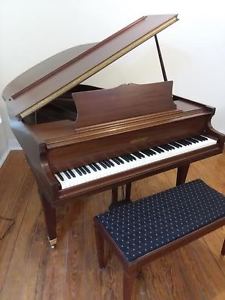
Chickering Baby Grand Piano
Estimated price for orientation: 1 900 $
Category: Grand and Baby Grand Pianos
Class:
Description Brand: Chickering Number of Pedals: 3 Type: Baby Grand Piano Country/Region of Manufacture: United States Number of Keys: 88
This Piano has been cared for and maintained. A fine instrument for student , beginner or novice player ! Played daily and restored action.. beautiful ! Please ask any questions before bidding.. sold as is.. and no the sound board is not cracked. Serial Number 207765 Shipping responsibility of buyer! Chickering & Sons is often compared to Steinway & Sons for progressive innovation and profound technological advances in the history of piano manufacturing. But, in fact, cabinetmaking and piano making apprenticeships by Jonas Chickering predate Henry E. Steinway's arrival in the United States by more than 30 years. In 1823, Jonas Chickering joined partnership with James Stewart in Boston, Massachusetts under the company name, Stewart & Chickering. The two men worked closely together for three years, then went their separate ways (Stewart migrated to London, England). In that short time, though, Chickering's reputation as an inventor and innovator caught the attention and financial backing of John MacKay. Their partnership soon placed Boston on the map as a major piano building city of the 19th century.The partnership between Jonas Chickering and John Mackay was short lived due to the tragic disappearance of Mackay while on voyage to South America in search of exotic, superior rainforest hardwoods for Chickering's ever more popular pianos. Nevertheless, Chickering was determined to continue with the success that their partnership had procured. With much effort on Chickering's part, and following the commercial, piano merchandising strategies he had learned from Mackay, word of Chickering's superior workmanship quickly spread to cities, towns and villages throughout the United States, Great Britain and Europe.Chickering was one of the companies that succeeded in making the transition from purely hand built production methods to more streamlined industrial procedures. By mid-century, Chickering had become extremely successful. Unlike other artisans who were unable to adapt to rapid growth and intense competition, Chickering was showing no signs of a downturn in production or capitol. This offered Jonas both time and money for even more in depth piano research and development.Then, tragedy struck the Chickering factory. The Tremont Street facility caught fire in December of 1852 and burned to the ground. Still, even though Chickering would have to start afresh, his determination soon produced an entirely new and even better factory, but the toll was not without consequences. A year later, Jonas Chickering died.Just before Jonas Chickering's death, his three sons were signed into the company as partners and the piano company's name became "Chickering & Sons." The oldest of the three brothers, Thomas E. Chickering, took charge of the public relations and merchandising aspects of the business and was perhaps even more successful than Jonas Chickering in improving the company's reputation. Twenty years later, Thomas Chickering died, leaving C. Frank Chickering in command. Before this, C. Frank Chickering had concentrated, like his father had done, on furthering design innovations for the Chickering piano line. He had gained much experience by traveling and studying piano technology in Europe and Great Britain while his father, Jonas Chickering was still alive.While Chickering & Sons was at the height of its reputation and popularity as the premier piano manufacturing in the United States, the brothers opened Chickering Hall on Fifth Avenue in New York City. This offered the company an opportunity to feature the world's greatest pianists and performers to play and thereby promote Chickering grand pianos. As well, Chickering Hall soon became a favorite venue for for many local musical organizations like the Mendelssohn Club and the New York Vocal Society.The youngest Chickering brother, George H. Chickering also greatly contributed to the success of Chickering & Sons. George studied hard to become a master piano craftsman. According to the historian, Alfred Dolge, for years George Chickering took pride in making every set of hammers for all the grand pianos built in their Boston factory. This type of hands-on approach became the inspiration for many piano craftsmen doing skilled bench work and repair work during this robust time in the history of piano manufacturing.Chickering Brothers, Chicago
The Chickering name is also associated with the city of Chicago. In 1892, long after the death of Jonas Chickering and while the Chickering name was still considered to be the very best piano manufacturing company in the world, the sons opened a factory in Chicago. The Chicago factory was named 'Chickering Brothers' to distinguish the factory and its pianos from the Boston line. Two famous Chickering grand piano brand names coming from the Chicago factory were the "Acoustigrand" and the "Capacoustigrand."Although the eastern seaboard was considered the primary location for piano manufacturing during the 19th century, Chicago manufacturing put Illinois on the map as a rival manufacturing location for the production of the world's best, highest quality pianos. Journalists and writers during this time spoke highly of the Chicago piano manufacturing scene. In the words of Alfred Dolge:The fact that Chicago has, during the past decade, become the greatest piano market in the world is largely due to the energy and enterprise of firms like Smith, Barnes & Strohber Company, Price & Teeple, Hobart M. Cable Company, Schaeffer Piano Mfg. Company, Cable-Nelson Piano Company, Adam Schaaf, Schiller Piano Company, the Haddorff Piano Company, the Straube Piano Company, P. A. Starck Company, Arthur P. King, H. P. Nelson Company, and others, who manufacture pianos in quantities of from 3,000 to 15,000 per year in their modern establishments.
Description
| Brand: | Chickering | Number of Pedals: | 3 |
| Type: | Baby Grand Piano | Country/Region of Manufacture: | United States |
| Number of Keys: | 88 |
This Piano has been cared for and maintained. A fine instrument for student , beginner or novice player ! Played daily and restored action.. beautiful ! Please ask any questions before bidding.. sold as is.. and no the sound board is not cracked. Serial Number 207765 Shipping responsibility of buyer! Chickering & Sons is often compared to Steinway & Sons for progressive innovation and profound technological advances in the history of piano manufacturing. But, in fact, cabinetmaking and piano making apprenticeships by Jonas Chickering predate Henry E. Steinway's arrival in the United States by more than 30 years. In 1823, Jonas Chickering joined partnership with James Stewart in Boston, Massachusetts under the company name, Stewart & Chickering. The two men worked closely together for three years, then went their separate ways (Stewart migrated to London, England). In that short time, though, Chickering's reputation as an inventor and innovator caught the attention and financial backing of John MacKay. Their partnership soon placed Boston on the map as a major piano building city of the 19th century.The partnership between Jonas Chickering and John Mackay was short lived due to the tragic disappearance of Mackay while on voyage to South America in search of exotic, superior rainforest hardwoods for Chickering's ever more popular pianos. Nevertheless, Chickering was determined to continue with the success that their partnership had procured. With much effort on Chickering's part, and following the commercial, piano merchandising strategies he had learned from Mackay, word of Chickering's superior workmanship quickly spread to cities, towns and villages throughout the United States, Great Britain and Europe.Chickering was one of the companies that succeeded in making the transition from purely hand built production methods to more streamlined industrial procedures. By mid-century, Chickering had become extremely successful. Unlike other artisans who were unable to adapt to rapid growth and intense competition, Chickering was showing no signs of a downturn in production or capitol. This offered Jonas both time and money for even more in depth piano research and development.Then, tragedy struck the Chickering factory. The Tremont Street facility caught fire in December of 1852 and burned to the ground. Still, even though Chickering would have to start afresh, his determination soon produced an entirely new and even better factory, but the toll was not without consequences. A year later, Jonas Chickering died.Just before Jonas Chickering's death, his three sons were signed into the company as partners and the piano company's name became "Chickering & Sons." The oldest of the three brothers, Thomas E. Chickering, took charge of the public relations and merchandising aspects of the business and was perhaps even more successful than Jonas Chickering in improving the company's reputation. Twenty years later, Thomas Chickering died, leaving C. Frank Chickering in command. Before this, C. Frank Chickering had concentrated, like his father had done, on furthering design innovations for the Chickering piano line. He had gained much experience by traveling and studying piano technology in Europe and Great Britain while his father, Jonas Chickering was still alive.While Chickering & Sons was at the height of its reputation and popularity as the premier piano manufacturing in the United States, the brothers opened Chickering Hall on Fifth Avenue in New York City. This offered the company an opportunity to feature the world's greatest pianists and performers to play and thereby promote Chickering grand pianos. As well, Chickering Hall soon became a favorite venue for for many local musical organizations like the Mendelssohn Club and the New York Vocal Society.The youngest Chickering brother, George H. Chickering also greatly contributed to the success of Chickering & Sons. George studied hard to become a master piano craftsman. According to the historian, Alfred Dolge, for years George Chickering took pride in making every set of hammers for all the grand pianos built in their Boston factory. This type of hands-on approach became the inspiration for many piano craftsmen doing skilled bench work and repair work during this robust time in the history of piano manufacturing.Chickering Brothers, Chicago
The Chickering name is also associated with the city of Chicago. In 1892, long after the death of Jonas Chickering and while the Chickering name was still considered to be the very best piano manufacturing company in the world, the sons opened a factory in Chicago. The Chicago factory was named 'Chickering Brothers' to distinguish the factory and its pianos from the Boston line. Two famous Chickering grand piano brand names coming from the Chicago factory were the "Acoustigrand" and the "Capacoustigrand."Although the eastern seaboard was considered the primary location for piano manufacturing during the 19th century, Chicago manufacturing put Illinois on the map as a rival manufacturing location for the production of the world's best, highest quality pianos. Journalists and writers during this time spoke highly of the Chicago piano manufacturing scene. In the words of Alfred Dolge:The fact that Chicago has, during the past decade, become the greatest piano market in the world is largely due to the energy and enterprise of firms like Smith, Barnes & Strohber Company, Price & Teeple, Hobart M. Cable Company, Schaeffer Piano Mfg. Company, Cable-Nelson Piano Company, Adam Schaaf, Schiller Piano Company, the Haddorff Piano Company, the Straube Piano Company, P. A. Starck Company, Arthur P. King, H. P. Nelson Company, and others, who manufacture pianos in quantities of from 3,000 to 15,000 per year in their modern establishments.
The Chickering name is also associated with the city of Chicago. In 1892, long after the death of Jonas Chickering and while the Chickering name was still considered to be the very best piano manufacturing company in the world, the sons opened a factory in Chicago. The Chicago factory was named 'Chickering Brothers' to distinguish the factory and its pianos from the Boston line. Two famous Chickering grand piano brand names coming from the Chicago factory were the "Acoustigrand" and the "Capacoustigrand."Although the eastern seaboard was considered the primary location for piano manufacturing during the 19th century, Chicago manufacturing put Illinois on the map as a rival manufacturing location for the production of the world's best, highest quality pianos. Journalists and writers during this time spoke highly of the Chicago piano manufacturing scene. In the words of Alfred Dolge:The fact that Chicago has, during the past decade, become the greatest piano market in the world is largely due to the energy and enterprise of firms like Smith, Barnes & Strohber Company, Price & Teeple, Hobart M. Cable Company, Schaeffer Piano Mfg. Company, Cable-Nelson Piano Company, Adam Schaaf, Schiller Piano Company, the Haddorff Piano Company, the Straube Piano Company, P. A. Starck Company, Arthur P. King, H. P. Nelson Company, and others, who manufacture pianos in quantities of from 3,000 to 15,000 per year in their modern establishments.