Back to the main page Back to category Harps and Dulcimers
musical instrument details
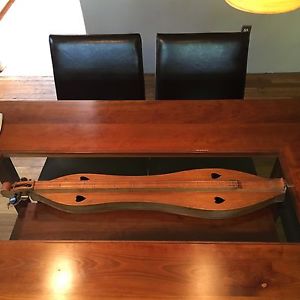
Jethro Amburgey dulcimer 1971. Signed and dated by legendary maker.
Estimated price for orientation: 620 $
Category: Harps and Dulcimers
Class:
Description Condition: Used: An item that has been used previously. The item may have some signs of cosmetic wear, but is fully operational and functions as intended. This item may be a floor model or store return that has been used. See the seller’s listing for full details and description of any imperfections. See all condition definitions- opens in a new window or tab ... Read moreabout the condition
A virtually-identical Amburgey instrument is on display in the Tennesse State Museum in Nashville. (pictures can be viewed by visiting the Appalachian Dulcimer Archive site online)
Excerpt of Jethro Amburgey's bio from "Appalachian Mountain Dulcimers":Jethro Amburgey, 1895–1971 of Knott County, KY was probably the single most influential dulcimer maker of the 20th century. An apprentice to the master, James Edward “Uncle Ed” Thomas about 1920. Amburgey and his luthierie constituted a direct link to the very earliest days of the mountain dulcimer. For most of his adult life, Amburgey plied his craft at the Hindman Settlement School in Knott County, where he had attended as a boy. He took a job as the school's woodworking teacher in 1931 and remained there until his death 40 years later.In the early 1930s, he was sought out by the composer, folk singer and fellow Kentuckian, John Jacob Niles Niles, who built a variety of unusual instruments based on traditional designs, studied Amburgey’s building techniques and commissioned dulcimers from Amburgey for use in his performances.When the folk singer Jean Ritchie -- Amburgey’s distant cousin from nearby Viper, KY -- arrived on the New York folk scene in the 1950s, she brought with her one of his dulcimers. After she wrote of Amburgey in the “The Dulcimer Book” (Oak Publications, 1963), orders started pouring in from all over the world.His earliest instruments are virtually indistinguishable from those of his mentor, except that (according to Ritchie) they were unpainted. According to Homer Ledford, Amburgey made some modifications in the early 1930s, perhaps under the influence of Niles, to improve resonance and volume. At some point in the 1950s, Amburgey started experimenting with plywoods, and by the early 1960s most of his instruments were made almost entirely of laminates.
Description
| Condition: | Used: An item that has been used previously. The item may have some signs of cosmetic wear, but is fully operational and functions as intended. This item may be a floor model or store return that has been used. See the seller’s listing for full details and description of any imperfections. See all condition definitions- opens in a new window or tab ... Read moreabout the condition |
A virtually-identical Amburgey instrument is on display in the Tennesse State Museum in Nashville. (pictures can be viewed by visiting the Appalachian Dulcimer Archive site online)
Excerpt of Jethro Amburgey's bio from "Appalachian Mountain Dulcimers":Jethro Amburgey, 1895–1971 of Knott County, KY was probably the single most influential dulcimer maker of the 20th century. An apprentice to the master, James Edward “Uncle Ed” Thomas about 1920. Amburgey and his luthierie constituted a direct link to the very earliest days of the mountain dulcimer. For most of his adult life, Amburgey plied his craft at the Hindman Settlement School in Knott County, where he had attended as a boy. He took a job as the school's woodworking teacher in 1931 and remained there until his death 40 years later.In the early 1930s, he was sought out by the composer, folk singer and fellow Kentuckian, John Jacob Niles Niles, who built a variety of unusual instruments based on traditional designs, studied Amburgey’s building techniques and commissioned dulcimers from Amburgey for use in his performances.When the folk singer Jean Ritchie -- Amburgey’s distant cousin from nearby Viper, KY -- arrived on the New York folk scene in the 1950s, she brought with her one of his dulcimers. After she wrote of Amburgey in the “The Dulcimer Book” (Oak Publications, 1963), orders started pouring in from all over the world.His earliest instruments are virtually indistinguishable from those of his mentor, except that (according to Ritchie) they were unpainted. According to Homer Ledford, Amburgey made some modifications in the early 1930s, perhaps under the influence of Niles, to improve resonance and volume. At some point in the 1950s, Amburgey started experimenting with plywoods, and by the early 1960s most of his instruments were made almost entirely of laminates.