Back to the main page Back to category Acoustic Guitars
musical instrument details
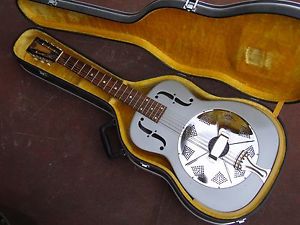
1935 NATIONAL DUOLIAN RESONATOR GUITAR
Estimated price for orientation: 1 499 $
Category: Acoustic Guitars
Class:
Description Brand: NATIONAL Body Type: DUOLIAN Dexterity: RIGHT-HANDED Exact Year: 1935 Country/Region of Manufacture: United States
This guitar was purchased new in 1935 by a gentleman who was learning to play guitar. He died 5yrs after buying it and it remained in his family until I purchased it several years ago. It has clearly been played very little.I believe the body has been repainted. Don at National Guitars advised me that there is a slim possibility it was a special order.The neck is in near new condition and appears to have had a protective layer of lacquer applied.The fretboard has little finger oil on it and the frets are almost as new.It sounds awesome.There is a paint chip on the body and the neck has a slight curve from being stored with the strings under tension for many years. The action is a little high because of the slight curve and a high nut. These C-series green/grey Duolians were made from 1931 to 1935.I'm selling it because I'm a lefty and it needs to be played and appreciated.Please ask any questions (6049254466) you may have before bidding and I can supply additional photos on request.Shipping charge will be a flat rate $60 to United States and Canada. I will cover any overage."National resonator instruments made from 1928 to 1940 were louder than conventional acoustic guitars of the era. They were also very popular with Hawaiian and Blues musicians in the late 1920's and early 1930's. In the single resonator models the convex 9.5" diameter cone has a maple "biscuit" on top of the cone. The biscuit has a wooden maple saddle which the strings pass over, like a conventional acoustic flat top guitar. But unlike flattop acoustic guitars where the vibration of the wooden body creates the sound, in a National resonator instrument the body acts as a speaker cabinet. When the strings are played, the vibration goes through the saddle to the bridge and then vibrates the speaker cone causing it to "resonate" and amplify the sound. Because there is fairly direct transmission of vibration from the strings to the resonator, the single resonator guitar is the loudest of the resonator guitars."
Description
| Brand: | NATIONAL | Body Type: | DUOLIAN |
| Dexterity: | RIGHT-HANDED | Exact Year: | 1935 |
| Country/Region of Manufacture: | United States |
This guitar was purchased new in 1935 by a gentleman who was learning to play guitar. He died 5yrs after buying it and it remained in his family until I purchased it several years ago. It has clearly been played very little.I believe the body has been repainted. Don at National Guitars advised me that there is a slim possibility it was a special order.The neck is in near new condition and appears to have had a protective layer of lacquer applied.The fretboard has little finger oil on it and the frets are almost as new.It sounds awesome.There is a paint chip on the body and the neck has a slight curve from being stored with the strings under tension for many years. The action is a little high because of the slight curve and a high nut. These C-series green/grey Duolians were made from 1931 to 1935.I'm selling it because I'm a lefty and it needs to be played and appreciated.Please ask any questions (6049254466) you may have before bidding and I can supply additional photos on request.Shipping charge will be a flat rate $60 to United States and Canada. I will cover any overage.
"National resonator instruments made from 1928 to 1940 were louder than conventional acoustic guitars of the era. They were also very popular with Hawaiian and Blues musicians in the late 1920's and early 1930's. In the single resonator models the convex 9.5" diameter cone has a maple "biscuit" on top of the cone. The biscuit has a wooden maple saddle which the strings pass over, like a conventional acoustic flat top guitar. But unlike flattop acoustic guitars where the vibration of the wooden body creates the sound, in a National resonator instrument the body acts as a speaker cabinet. When the strings are played, the vibration goes through the saddle to the bridge and then vibrates the speaker cone causing it to "resonate" and amplify the sound. Because there is fairly direct transmission of vibration from the strings to the resonator, the single resonator guitar is the loudest of the resonator guitars."