Back to the main page Back to category Upright Pianos
musical instrument details
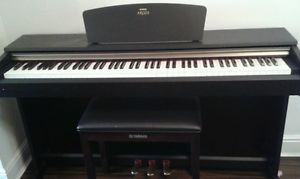
Yamaha Arius Electronic Piano Perfect Barely Played Condition with stool.
Estimated price for orientation: 450 $
Category: Upright Pianos
Class:
Description Condition: Used: An item that has been used previously. The item may have some signs of cosmetic wear, but is fully operational and functions as intended. This item may be a floor model or store return that has been used. See the seller’s listing for full details and description of any imperfections. See all condition definitions- opens in a new window or tab ... Read moreabout the condition Type: Piano Brand: Yamaha
Excellent condition and beautiful sounding piano. Cost £1000 new.Open to reasonable offers. Cash on collection please.
The Yamaha YDP-161 is a superb piano for the home. Thanks to its compact and stylish design, superb sound quality and realistic piano feel and response it is ideally suited to both complete beginners and the more advanced player. If you are looking for an instrument on which to start learning, an upgrade from a keyboard or old acoustic instrument or perhaps you'd like to take up the piano again after not playing for a while, the YDP-161 is a great choice. Despite it's compact size, the keyboard has a full 88 notes and is exactly the same size as a normal piano. It has the standard 3 pedals (Damper, Sostenuto and Soft) and a sliding key cover for when the instrument is not in use. The sound and touch of a Yamaha piano...
A piano has to sound good - this makes practising effortless and playing a pleasure. As the world's largest manufacturer of traditional pianos and a leader in digital and acoustic technologies, Yamaha is uniquely placed to produce a digital piano that emulates the sound and touch of a real acoustic grand. Why does it sound so good?
The sound you hear when you play the YDP-161 is actually that of a real Yamaha concert grand piano just like you would see on stage in concert halls around the world . The sound of the piano has been digitally sampled and stored so that, for example, when you play a C on your YDP-161, you hear the C played on the grand piano. But there's much more to it than that....depending on how hard you play the keys, the sound of a piano changes; the YDP-161 perfectly recreates this as you play thanks to its touch-sensitive keyboard. Furthermore, when using the damper (or sustain) pedal, the subtle changes in tone that this causes are replicated, thanks to the Damper Resonance feature. These technologies, working in harmony, mean that the quality of the piano sound has to be heard to be believed. Why is the feel of the keyboard so important?
Of course, a piano must sound good, but experienced pianists will tell you that how the keyboard feels and responds as you play is equally important. Some digital pianos may sound good, but they do not feel and respond like a real piano. This means that it becomes difficult to control the expression of the music and makes the instrument very unenjoyable to play. For the beginner this is a major problem, as the correct physical keyboard control skills are not being developed during the learning process. An upright or grand piano's keyboard is heavier to the touch than a small electronic keyboard, organ or synthesizer. That's because when you play the key, you are making a hammer hit a string to play the note. Learning on an instrument with a weighted keyboard is essential if you want to play the piano, otherwise you will become used to a lighter action which will make playing an acoustic piano much more challenging. Yamaha's knowledge of many years of acoustic piano manufacture has gone into developing a digital instrument which feels just like a traditional piano with hammers and strings. This even ensures that lower notes are slightly heavier to the touch than higher ones - exactly as you would find on an acoustic instrument - so you can learn to play with confidence knowing that you can move to another piano without it feeling totally different. Furthermore, if the player is unable to strike the keys with enough pressure because, for example, they are very young or have an injury, the touch sensitivity of the piano can be adjusted or even turned off completely, something that is not possible on a piano with strings! Much more than a piano
Of course, other instrument sounds can be created using Yamaha's sampling technology. YDP-161 has a total of 10 different sounds: Grand Piano 1 Recorded samples from a full concert grand piano. Perfect for classical compositions as well as any other style that requires acoustic piano.
Grand Piano 2 Spacious and clear with a bright reverb. Great for popular music.
E.Piano 1 An iconic electric piano sound created using FM synthesis.
E.Piano 2 A traditional electric piano with using hammer-struck 'tines'. It has a soft tone when played lightly and a much more aggressive tone when played hard.
Harpsichord 1 The definitive instrument for baroque music. Since the strings of a harpsichord and plucked, there is no touch response.
Harpsichord 2 Mixes the same voice an octave higher for a full tone.
Vibraphone The sound of a vibraphone played with soft mallets.
Church Organ 1 This is a typical pipe organ sound (8ft + 4ft + 2ft). Ideal for sacred music from the Baroque period.
Church Organ 2 The full sound of a pipe organ, organ associated with Bach's Toccata and Fugue.
Strings A spacious and warm string ensemble. Try combining this voice with a piano in DUAL mode (see below).
Any two voices can be combined using the dual feature so that, for example, you can play piano together with rich strings to create a great orchestral effect. To further enhance the sound, digital reverb can be added, creating the ambience of a concert hall in any room or even when playing with headphones.
Description
| Condition: | Used: An item that has been used previously. The item may have some signs of cosmetic wear, but is fully operational and functions as intended. This item may be a floor model or store return that has been used. See the seller’s listing for full details and description of any imperfections. See all condition definitions- opens in a new window or tab ... Read moreabout the condition | Type: | Piano |
| Brand: | Yamaha |
Excellent condition and beautiful sounding piano. Cost £1000 new.Open to reasonable offers. Cash on collection please.
The Yamaha YDP-161 is a superb piano for the home. Thanks to its compact and stylish design, superb sound quality and realistic piano feel and response it is ideally suited to both complete beginners and the more advanced player. If you are looking for an instrument on which to start learning, an upgrade from a keyboard or old acoustic instrument or perhaps you'd like to take up the piano again after not playing for a while, the YDP-161 is a great choice. Despite it's compact size, the keyboard has a full 88 notes and is exactly the same size as a normal piano. It has the standard 3 pedals (Damper, Sostenuto and Soft) and a sliding key cover for when the instrument is not in use. The sound and touch of a Yamaha piano...
A piano has to sound good - this makes practising effortless and playing a pleasure. As the world's largest manufacturer of traditional pianos and a leader in digital and acoustic technologies, Yamaha is uniquely placed to produce a digital piano that emulates the sound and touch of a real acoustic grand. Why does it sound so good?
The sound you hear when you play the YDP-161 is actually that of a real Yamaha concert grand piano just like you would see on stage in concert halls around the world . The sound of the piano has been digitally sampled and stored so that, for example, when you play a C on your YDP-161, you hear the C played on the grand piano. But there's much more to it than that....depending on how hard you play the keys, the sound of a piano changes; the YDP-161 perfectly recreates this as you play thanks to its touch-sensitive keyboard. Furthermore, when using the damper (or sustain) pedal, the subtle changes in tone that this causes are replicated, thanks to the Damper Resonance feature. These technologies, working in harmony, mean that the quality of the piano sound has to be heard to be believed. Why is the feel of the keyboard so important?
Of course, a piano must sound good, but experienced pianists will tell you that how the keyboard feels and responds as you play is equally important. Some digital pianos may sound good, but they do not feel and respond like a real piano. This means that it becomes difficult to control the expression of the music and makes the instrument very unenjoyable to play. For the beginner this is a major problem, as the correct physical keyboard control skills are not being developed during the learning process. An upright or grand piano's keyboard is heavier to the touch than a small electronic keyboard, organ or synthesizer. That's because when you play the key, you are making a hammer hit a string to play the note. Learning on an instrument with a weighted keyboard is essential if you want to play the piano, otherwise you will become used to a lighter action which will make playing an acoustic piano much more challenging. Yamaha's knowledge of many years of acoustic piano manufacture has gone into developing a digital instrument which feels just like a traditional piano with hammers and strings. This even ensures that lower notes are slightly heavier to the touch than higher ones - exactly as you would find on an acoustic instrument - so you can learn to play with confidence knowing that you can move to another piano without it feeling totally different. Furthermore, if the player is unable to strike the keys with enough pressure because, for example, they are very young or have an injury, the touch sensitivity of the piano can be adjusted or even turned off completely, something that is not possible on a piano with strings! Much more than a piano
Of course, other instrument sounds can be created using Yamaha's sampling technology. YDP-161 has a total of 10 different sounds: Grand Piano 1 Recorded samples from a full concert grand piano. Perfect for classical compositions as well as any other style that requires acoustic piano.
Grand Piano 2 Spacious and clear with a bright reverb. Great for popular music.
E.Piano 1 An iconic electric piano sound created using FM synthesis.
E.Piano 2 A traditional electric piano with using hammer-struck 'tines'. It has a soft tone when played lightly and a much more aggressive tone when played hard.
Harpsichord 1 The definitive instrument for baroque music. Since the strings of a harpsichord and plucked, there is no touch response.
Harpsichord 2 Mixes the same voice an octave higher for a full tone.
Vibraphone The sound of a vibraphone played with soft mallets.
Church Organ 1 This is a typical pipe organ sound (8ft + 4ft + 2ft). Ideal for sacred music from the Baroque period.
Church Organ 2 The full sound of a pipe organ, organ associated with Bach's Toccata and Fugue.
Strings A spacious and warm string ensemble. Try combining this voice with a piano in DUAL mode (see below).
Any two voices can be combined using the dual feature so that, for example, you can play piano together with rich strings to create a great orchestral effect. To further enhance the sound, digital reverb can be added, creating the ambience of a concert hall in any room or even when playing with headphones.
The Yamaha YDP-161 is a superb piano for the home. Thanks to its compact and stylish design, superb sound quality and realistic piano feel and response it is ideally suited to both complete beginners and the more advanced player. If you are looking for an instrument on which to start learning, an upgrade from a keyboard or old acoustic instrument or perhaps you'd like to take up the piano again after not playing for a while, the YDP-161 is a great choice. Despite it's compact size, the keyboard has a full 88 notes and is exactly the same size as a normal piano. It has the standard 3 pedals (Damper, Sostenuto and Soft) and a sliding key cover for when the instrument is not in use. The sound and touch of a Yamaha piano...
A piano has to sound good - this makes practising effortless and playing a pleasure. As the world's largest manufacturer of traditional pianos and a leader in digital and acoustic technologies, Yamaha is uniquely placed to produce a digital piano that emulates the sound and touch of a real acoustic grand. Why does it sound so good?
The sound you hear when you play the YDP-161 is actually that of a real Yamaha concert grand piano just like you would see on stage in concert halls around the world . The sound of the piano has been digitally sampled and stored so that, for example, when you play a C on your YDP-161, you hear the C played on the grand piano. But there's much more to it than that....depending on how hard you play the keys, the sound of a piano changes; the YDP-161 perfectly recreates this as you play thanks to its touch-sensitive keyboard. Furthermore, when using the damper (or sustain) pedal, the subtle changes in tone that this causes are replicated, thanks to the Damper Resonance feature. These technologies, working in harmony, mean that the quality of the piano sound has to be heard to be believed. Why is the feel of the keyboard so important?
Of course, a piano must sound good, but experienced pianists will tell you that how the keyboard feels and responds as you play is equally important. Some digital pianos may sound good, but they do not feel and respond like a real piano. This means that it becomes difficult to control the expression of the music and makes the instrument very unenjoyable to play. For the beginner this is a major problem, as the correct physical keyboard control skills are not being developed during the learning process. An upright or grand piano's keyboard is heavier to the touch than a small electronic keyboard, organ or synthesizer. That's because when you play the key, you are making a hammer hit a string to play the note. Learning on an instrument with a weighted keyboard is essential if you want to play the piano, otherwise you will become used to a lighter action which will make playing an acoustic piano much more challenging. Yamaha's knowledge of many years of acoustic piano manufacture has gone into developing a digital instrument which feels just like a traditional piano with hammers and strings. This even ensures that lower notes are slightly heavier to the touch than higher ones - exactly as you would find on an acoustic instrument - so you can learn to play with confidence knowing that you can move to another piano without it feeling totally different. Furthermore, if the player is unable to strike the keys with enough pressure because, for example, they are very young or have an injury, the touch sensitivity of the piano can be adjusted or even turned off completely, something that is not possible on a piano with strings! Much more than a piano
Of course, other instrument sounds can be created using Yamaha's sampling technology. YDP-161 has a total of 10 different sounds: Grand Piano 1 Recorded samples from a full concert grand piano. Perfect for classical compositions as well as any other style that requires acoustic piano.
Grand Piano 2 Spacious and clear with a bright reverb. Great for popular music.
E.Piano 1 An iconic electric piano sound created using FM synthesis.
E.Piano 2 A traditional electric piano with using hammer-struck 'tines'. It has a soft tone when played lightly and a much more aggressive tone when played hard.
Harpsichord 1 The definitive instrument for baroque music. Since the strings of a harpsichord and plucked, there is no touch response.
Harpsichord 2 Mixes the same voice an octave higher for a full tone.
Vibraphone The sound of a vibraphone played with soft mallets.
Church Organ 1 This is a typical pipe organ sound (8ft + 4ft + 2ft). Ideal for sacred music from the Baroque period.
Church Organ 2 The full sound of a pipe organ, organ associated with Bach's Toccata and Fugue.
Strings A spacious and warm string ensemble. Try combining this voice with a piano in DUAL mode (see below).
Any two voices can be combined using the dual feature so that, for example, you can play piano together with rich strings to create a great orchestral effect. To further enhance the sound, digital reverb can be added, creating the ambience of a concert hall in any room or even when playing with headphones.