Back to the main page Back to category Vintage and Antique
musical instrument details
Manuscript Hymn Tune Book 1793 Early American Songs Welsh Wales Hymnary
Estimated price for orientation: 1 200 $
Category: Vintage and Antique
Class:
Description Condition: Used: An item that has been used previously. See the seller’s listing for full details and description of any imperfections. See all condition definitions- opens in a new window or tab ... Read moreabout the condition
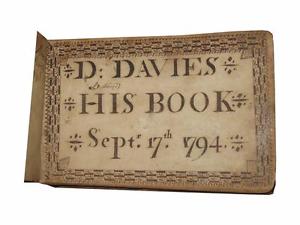
[Hymnary][Manuscripts] Davies, David (1763-1816). A Collection of Psalm, and Hymn, Tunes Adapted for Publick Worship. [Berthloyd?, Wales]: 1794. Oblong, 3 5/8” x 5 3/8”. Full calf with brass clasps. Manuscript pagination: (i-xxiv), 1-125, (126-148), (blank, 3). Good: light scattered foxing, boards heavily worn; a couple leaves detached (including ownership leaf), front board detached, rear board nearly so. Lacking leaves that make up pages 39/40, 51/52, and 69/70. A manuscript collection of Psalm and hymn tunes by that we believe was created by an important Welsh preacher. From The Dictionary of Welsh Biography: “David Davies was born in Swansea, Wales, in 1763, the son of an inn-keeper, and died the day after Christmas in 1816. He was an Independent minister, first at the Arminian-Arian congregation of Pen-rhiw, but soon turned to the Calvinistic Independents of Pen-cader. About 1784-1785 he began preaching, and in 1790 became Assistant Minister of the church at Llangeler. This congregation was on the point of extinction, but Davies grew the congregation that a new chapel had to be built in 1792. Monthly he visited and preached at the rather distant churches at Neuadd-lwyd and Gwernogle. In 1795 he was called to succeed Lewis Rees in the pastorate of Mynydd-back (Swansea) and its branches. Here again he was remarkably successful, and in 1803 built the Ebenezer Chapel in Swansea. Davies is an historical figure among Welsh Independents; some indeed would claim that he was their greatest preacher. In him, for the first time it would seem, they departed from the older Presbyterian and Independent tradition of a professionally-trained ministry, realizing the influence of the Methodist Revival upon the Older Dissent. He was an indefatigable itinerant, and an exceptionally powerful preacher. He devoted his life to mission work, establishing new churches, and training preachers. He also wrote a large number of hymns.” The book starts with a magnificently drawn ownership page with elaborate borders and markings. It’s followed by over 20 pages of musical instruction: descriptions of notes and intervals, graphical depiction of keeping time, list of the marks used in music, the scales, concords and discords. What follows is an alphabetized collection of over 80 hymn tunes, only 1 or 2 with lyrics. We know Davies had a collection of his hymns published as we were able to locate an 1832 second edition of them published by E. Griffiths, Swansea. Most of the tunes as composed in the manuscript are unknown to the several scholars we consulted, and we believe that many are Davies’ original compositions. One source states that 70 of his hymns have passed into recent hymnbooks but we do not know if any of the tunes offered here have been published. As the manuscript contains very little text, we believe Davies composed many of these tunes in a variety of popular meters for a song leader, pastor, or congregation to pair up with the texts they would be singing. While some of the titles of the tunes are known today, Davies’ compositions of them are usually different. It’s possible that Davies was incorporating his ideas with the Welsh tradition of memorization of hymns, such that the book could have been used by a church’s music leader as he led the congregation in a tune to which they already knew the words. Another interesting aspect of the manuscript is the four tunes with American association (American Delight, Chester, Portsmouth, and Washington). American Delight was not published until 1798; Washington was published far later. We therefore believe that Davies’ was either acquainted with an American musician or somehow managed to acquire manuscript versions of American songs. A beautiful, flourishing example of what we believe to be a minister/musician’s effort to improve and enhance congregational song in both the context of worship and social events of the era. A very special thank you to Michael Morgan for his assistance in our research. Michael is a church musician, Psalm scholar, and collector of English Bibles and Psalters from Atlanta, Georgia, where he has served as organist for Central Presbyterian Church for over 35 years, and is also organist at Columbia Theological Seminary. He is author of the Psalter for Christian Worship (revised edition, 2010), and a regular contributor in the field of psalmody (most recently to the Reformed collection Psalms for All Seasons and to the new Presbyterian hymnal, Glory to God, publishing in 2013. Many more photos may be found here: Please do not hesitate to contact us for additional information and/or photos and we will respond promptly. We package our items carefully, ship daily, and have a no hassle returns policy--your satisfaction is guaranteed. We are members of the Texas Booksellers Association and the Independent Online Booksellers Association and adhere to their rules of ethics. UNLESS OTHERWISE EXPLICITLY STATED, ALL ITEMS ARE GUARANTEED TO BE AUTHENTIC AND ORIGINAL Terms and shipping: Payment is required within 3 days of purchase. Payment via paypal unless other arrangement
Description
| Condition: | Used: An item that has been used previously. See the seller’s listing for full details and description of any imperfections. See all condition definitions- opens in a new window or tab ... Read moreabout the condition |
[Hymnary][Manuscripts] Davies, David (1763-1816). A Collection of Psalm, and Hymn, Tunes Adapted for Publick Worship. [Berthloyd?, Wales]: 1794. Oblong, 3 5/8” x 5 3/8”. Full calf with brass clasps. Manuscript pagination: (i-xxiv), 1-125, (126-148), (blank, 3). Good: light scattered foxing, boards heavily worn; a couple leaves detached (including ownership leaf), front board detached, rear board nearly so. Lacking leaves that make up pages 39/40, 51/52, and 69/70. A manuscript collection of Psalm and hymn tunes by that we believe was created by an important Welsh preacher. From The Dictionary of Welsh Biography: “David Davies was born in Swansea, Wales, in 1763, the son of an inn-keeper, and died the day after Christmas in 1816. He was an Independent minister, first at the Arminian-Arian congregation of Pen-rhiw, but soon turned to the Calvinistic Independents of Pen-cader. About 1784-1785 he began preaching, and in 1790 became Assistant Minister of the church at Llangeler. This congregation was on the point of extinction, but Davies grew the congregation that a new chapel had to be built in 1792. Monthly he visited and preached at the rather distant churches at Neuadd-lwyd and Gwernogle. In 1795 he was called to succeed Lewis Rees in the pastorate of Mynydd-back (Swansea) and its branches. Here again he was remarkably successful, and in 1803 built the Ebenezer Chapel in Swansea. Davies is an historical figure among Welsh Independents; some indeed would claim that he was their greatest preacher. In him, for the first time it would seem, they departed from the older Presbyterian and Independent tradition of a professionally-trained ministry, realizing the influence of the Methodist Revival upon the Older Dissent. He was an indefatigable itinerant, and an exceptionally powerful preacher. He devoted his life to mission work, establishing new churches, and training preachers. He also wrote a large number of hymns.” The book starts with a magnificently drawn ownership page with elaborate borders and markings. It’s followed by over 20 pages of musical instruction: descriptions of notes and intervals, graphical depiction of keeping time, list of the marks used in music, the scales, concords and discords. What follows is an alphabetized collection of over 80 hymn tunes, only 1 or 2 with lyrics. We know Davies had a collection of his hymns published as we were able to locate an 1832 second edition of them published by E. Griffiths, Swansea. Most of the tunes as composed in the manuscript are unknown to the several scholars we consulted, and we believe that many are Davies’ original compositions. One source states that 70 of his hymns have passed into recent hymnbooks but we do not know if any of the tunes offered here have been published. As the manuscript contains very little text, we believe Davies composed many of these tunes in a variety of popular meters for a song leader, pastor, or congregation to pair up with the texts they would be singing. While some of the titles of the tunes are known today, Davies’ compositions of them are usually different. It’s possible that Davies was incorporating his ideas with the Welsh tradition of memorization of hymns, such that the book could have been used by a church’s music leader as he led the congregation in a tune to which they already knew the words. Another interesting aspect of the manuscript is the four tunes with American association (American Delight, Chester, Portsmouth, and Washington). American Delight was not published until 1798; Washington was published far later. We therefore believe that Davies’ was either acquainted with an American musician or somehow managed to acquire manuscript versions of American songs. A beautiful, flourishing example of what we believe to be a minister/musician’s effort to improve and enhance congregational song in both the context of worship and social events of the era. A very special thank you to Michael Morgan for his assistance in our research. Michael is a church musician, Psalm scholar, and collector of English Bibles and Psalters from Atlanta, Georgia, where he has served as organist for Central Presbyterian Church for over 35 years, and is also organist at Columbia Theological Seminary. He is author of the Psalter for Christian Worship (revised edition, 2010), and a regular contributor in the field of psalmody (most recently to the Reformed collection Psalms for All Seasons and to the new Presbyterian hymnal, Glory to God, publishing in 2013. Many more photos may be found here: Please do not hesitate to contact us for additional information and/or photos and we will respond promptly. We package our items carefully, ship daily, and have a no hassle returns policy--your satisfaction is guaranteed. We are members of the Texas Booksellers Association and the Independent Online Booksellers Association and adhere to their rules of ethics. UNLESS OTHERWISE EXPLICITLY STATED, ALL ITEMS ARE GUARANTEED TO BE AUTHENTIC AND ORIGINAL Terms and shipping: Payment is required within 3 days of purchase. Payment via paypal unless other arrangement