Back to the main page Back to category Synthesizers
musical instrument details
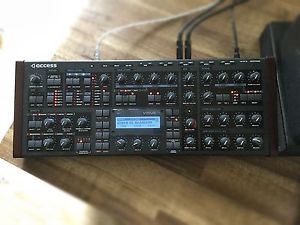
ACCESS Virus TI Desktop Synthesizer - mint condition
Estimated price for orientation: 815 $
Category: Synthesizers
Class:
Description Condition: Used: An item that has been used previously. The item may have some signs of cosmetic wear, but is fully operational and functions as intended. This item may be a floor model or store return that has been used. See the seller’s listing for full details and description of any imperfections. See all condition definitions- opens in a new window or tab ... Read moreabout the condition EAN: Nicht zutreffend
You are bidding on a ACCESS Virus TI in perfect condition. 100% function. High End synthesizer with VST/AU TOTAL INTEGRATION. The best integration of a hardware synth ever!This synthesizer will make any desktop proud! The TI Desktop features an all-metal enclosure with a wooden strip on the front. Loads of knobs and buttons give direct access to the most important sound shaping parameters. This range of instant access hands-on control will delight those who don't like menu diving. Like all other Virus TI synthesizers, a stereo analogue input offers the power to process external signals through the Virus' sound engine. An optional 19" rack mounting kit is available for purchase.Arguably the pinnacle of DSP-based digital synthesis at the moment. It could easily be written off as a Virus C with added supersaw, but the many improvements suggest revolution, not evolution!The TI includes several oscillator sources from simple sine/tri/saw through to wavetables (63 to choose from, nicely varied; the 64th wavetable is actually the pure sine wave) and also granular and formant sources based on the wavetables. The supersaw mode is present and allows big, spreadable saws with a huge unison effect - you can dial in over 100 oscillators per note if your mix (and your monitors) can take it.If you want it on a digital synth oscillator section, then this has it: 3 oscillators, multiple modes, FM (with several FM applications), oscillator sync, an additional subosc and a noise source. There'll be a bit of menu diving though - the TI may have more physical controls than any Virus before it, but options here outweigh controllers. Fortunately, the menus are logically laid out and fairly simple. The common parameters are on the front panel, and the most in-depth tweaking lies no more than four menu-pages under the hood.There are dual filters with multiple modes from Lowpass, Hipass, Bandpass, Bandreject to more DSP-intensive emulations of analog 1- , 2- and 4-pole modes (the so-called Minimoog emulation). These filters are what really make the synth and impart a definite character to the Virus. Most would agree that the Virus sounds dark and ominous rather than the bright, crisp sounds of the Clavias and Korgs. They whine and screech when you crank up the resonance into the self-oscillating regions as well! Regardless of whether the filter emulations perfectly copy the originals, or any preconceptions regarding what is analog or digital, these filters are a modern classic and can be argued to have already made it onto even more vinyl acreage than the venerable Minimoog. The Virus really IS several genres of dance music; as much a signature sound as the saxophone to modern be-bop. To dismiss it as a dance floor-only synth would be criminal, however.The Mod Matrix and LFO sections are comprehensive - 18 mod matrix slots, 3 LFO's (which can do double duty as simple third envelopes - although a 3rd envelope feature isn't expressly provided) which can do all the usual LFO tricks. The matrix can even modulate itself; perfect for sonic experiments, but it can be a test of memory (yours, not the synth's) remembering just what it is you're trying to modulate. Too many options may not be a valid complaint, but what this synth could really do with is a screen-based editor......And it's the computer integration which the TI does better than any other computer-age synth to date. There's a USB1 (not USB2, but fast enough for most tasks) interface which doubles as both a DSP audio interface for you computer and enables an onscreen librarian VST3/AU/RTAS plugin interface to appear in your software of choice. If you can do it on the synth, you can do it onscreen, except that some parameters (like arpeggiator settings) can only really be edited on the computer. On the subject of the arp, there's no step sequencer option, which is a shame because this synth really can nail those Berlin school drones and sequences.Virus TI software interfaceThe hardware is a metal-skinned, wooden-ended tank, with solid knobs that turn easily yet feel as though they're set in concrete. The desktop version lets you remove the wood, replace with rack ears, and tilt the I/O panel through 90 degrees so you don't lose a rack space above the unit - very clever. The keyed versions have the very best keybed available on a synthesizer today (synth-weight or semi-weight by Fatar); note that aftertouch is only monophonic. Tap-tempo and simple Oct+/- buttons which transpose semitones with a simple click of the 'shift' key; this keyboard makes for a great master controller for both computer-based and hardware-based sequencers. Multi-mode is available for the older-school studios with 16-channel MIDI multitimbrality. This is a synth for the computer age, but multi-mode is genuinely useable due to the synth's awesome dual-DSP polyphony. You'll run out of hardware sequencer notes before the synth does.Virus TI 5-octave keyboard modelRounding the synth is a studio-spec effects section, with delays (including tape delays - clocked and free running with modulation and bandwidth options), a great sounding reverb (which is used in perhaps a little too many of the 4,000 - yes 4,000 - factory presets) and EQ options with Q control. There's a distortion
Description
| Condition: | Used: An item that has been used previously. The item may have some signs of cosmetic wear, but is fully operational and functions as intended. This item may be a floor model or store return that has been used. See the seller’s listing for full details and description of any imperfections. See all condition definitions- opens in a new window or tab ... Read moreabout the condition | EAN: | Nicht zutreffend |
You are bidding on a ACCESS Virus TI in perfect condition. 100% function. High End synthesizer with VST/AU TOTAL INTEGRATION. The best integration of a hardware synth ever!This synthesizer will make any desktop proud! The TI Desktop features an all-metal enclosure with a wooden strip on the front. Loads of knobs and buttons give direct access to the most important sound shaping parameters. This range of instant access hands-on control will delight those who don't like menu diving. Like all other Virus TI synthesizers, a stereo analogue input offers the power to process external signals through the Virus' sound engine. An optional 19" rack mounting kit is available for purchase.Arguably the pinnacle of DSP-based digital synthesis at the moment. It could easily be written off as a Virus C with added supersaw, but the many improvements suggest revolution, not evolution!The TI includes several oscillator sources from simple sine/tri/saw through to wavetables (63 to choose from, nicely varied; the 64th wavetable is actually the pure sine wave) and also granular and formant sources based on the wavetables. The supersaw mode is present and allows big, spreadable saws with a huge unison effect - you can dial in over 100 oscillators per note if your mix (and your monitors) can take it.If you want it on a digital synth oscillator section, then this has it: 3 oscillators, multiple modes, FM (with several FM applications), oscillator sync, an additional subosc and a noise source. There'll be a bit of menu diving though - the TI may have more physical controls than any Virus before it, but options here outweigh controllers. Fortunately, the menus are logically laid out and fairly simple. The common parameters are on the front panel, and the most in-depth tweaking lies no more than four menu-pages under the hood.There are dual filters with multiple modes from Lowpass, Hipass, Bandpass, Bandreject to more DSP-intensive emulations of analog 1- , 2- and 4-pole modes (the so-called Minimoog emulation). These filters are what really make the synth and impart a definite character to the Virus. Most would agree that the Virus sounds dark and ominous rather than the bright, crisp sounds of the Clavias and Korgs. They whine and screech when you crank up the resonance into the self-oscillating regions as well! Regardless of whether the filter emulations perfectly copy the originals, or any preconceptions regarding what is analog or digital, these filters are a modern classic and can be argued to have already made it onto even more vinyl acreage than the venerable Minimoog. The Virus really IS several genres of dance music; as much a signature sound as the saxophone to modern be-bop. To dismiss it as a dance floor-only synth would be criminal, however.The Mod Matrix and LFO sections are comprehensive - 18 mod matrix slots, 3 LFO's (which can do double duty as simple third envelopes - although a 3rd envelope feature isn't expressly provided) which can do all the usual LFO tricks. The matrix can even modulate itself; perfect for sonic experiments, but it can be a test of memory (yours, not the synth's) remembering just what it is you're trying to modulate. Too many options may not be a valid complaint, but what this synth could really do with is a screen-based editor......And it's the computer integration which the TI does better than any other computer-age synth to date. There's a USB1 (not USB2, but fast enough for most tasks) interface which doubles as both a DSP audio interface for you computer and enables an onscreen librarian VST3/AU/RTAS plugin interface to appear in your software of choice. If you can do it on the synth, you can do it onscreen, except that some parameters (like arpeggiator settings) can only really be edited on the computer. On the subject of the arp, there's no step sequencer option, which is a shame because this synth really can nail those Berlin school drones and sequences.Virus TI software interfaceThe hardware is a metal-skinned, wooden-ended tank, with solid knobs that turn easily yet feel as though they're set in concrete. The desktop version lets you remove the wood, replace with rack ears, and tilt the I/O panel through 90 degrees so you don't lose a rack space above the unit - very clever. The keyed versions have the very best keybed available on a synthesizer today (synth-weight or semi-weight by Fatar); note that aftertouch is only monophonic. Tap-tempo and simple Oct+/- buttons which transpose semitones with a simple click of the 'shift' key; this keyboard makes for a great master controller for both computer-based and hardware-based sequencers. Multi-mode is available for the older-school studios with 16-channel MIDI multitimbrality. This is a synth for the computer age, but multi-mode is genuinely useable due to the synth's awesome dual-DSP polyphony. You'll run out of hardware sequencer notes before the synth does.Virus TI 5-octave keyboard modelRounding the synth is a studio-spec effects section, with delays (including tape delays - clocked and free running with modulation and bandwidth options), a great sounding reverb (which is used in perhaps a little too many of the 4,000 - yes 4,000 - factory presets) and EQ options with Q control. There's a distortion