Back to the main page Back to category Vintage Pro Audio Equipment
musical instrument details
Minod Vorga RARE analogue tabletop synthesizer
Estimated price for orientation: 1 000 $
Category: Vintage Pro Audio Equipment
Class:
Description Type: Vintage Synthesizer Model: Vorga Brand: Minod Country//Region of Manufacture: Sweden
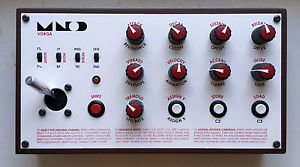
Much effort has been put into designing a fast and easy interface on the MINOD® VORGA. Much of this is accomlished by the joystick. The analog joystick by default controls pitch bend and modulation. But any other control can be assigned to it in any combination. For example, you can have filter cutoff frequency on the vertical axis and LFO frequency on the horizontal. The joystick is also used to load and store patches and sequences and to select MIDI channels. The VORGA can store sixteen sound patches and sixteen sequence patterns. It also supports SYSEX messages to upload or download patches and sequences. The VORGA has nine knobs and four switches. All knobs and switches have two different functions in any mode. One direct and one shifted. You will master the interface after a few minutes of practice. The red button is the shift button. All controls sends MIDI messages, so the MINOD® VORGA can be used as a MIDI controller as well. You will probably notice the brief instruction text on the front panel on the VORGA. It may come in handy when you need to change the MIDI channel or set the sequence length for example. The MINOD® VORGA filter is the backbone of its original sound. It has two modes set by a switch: 24dB Low pass (4-pole) or 12dB Band pass (2x2-pole) with variable width, where both ends are 2-pole or 12dB/oct. The cutoff frequency and bandwidth can be varied independently. What makes the filter unique is the two resonance peaks, one on each side of the band pass filter. This creates timbres not available on traditional analog synths. The drive control helps too. The filter has six parameters: cutoff, offset, resonance (dubbed Q in the schematic), drive, velocity, and envelope. The first controls the center frequency of the filter. The second controls the bandwidth. resonance sets the resonant response on both peaks. The drive controls the power driven into the filter and can give distortion effects. Velocity controls the MIDI velocity influence on the cutoff. Finally, envelope controls the amount of envelope influence on the cutoff frequencies.
Description
| Type: | Vintage Synthesizer | Model: | Vorga |
| Brand: | Minod | Country//Region of Manufacture: | Sweden |
Much effort has been put into designing a fast and easy interface on the MINOD® VORGA. Much of this is accomlished by the joystick. The analog joystick by default controls pitch bend and modulation. But any other control can be assigned to it in any combination. For example, you can have filter cutoff frequency on the vertical axis and LFO frequency on the horizontal. The joystick is also used to load and store patches and sequences and to select MIDI channels. The VORGA can store sixteen sound patches and sixteen sequence patterns. It also supports SYSEX messages to upload or download patches and sequences. The VORGA has nine knobs and four switches. All knobs and switches have two different functions in any mode. One direct and one shifted. You will master the interface after a few minutes of practice. The red button is the shift button. All controls sends MIDI messages, so the MINOD® VORGA can be used as a MIDI controller as well. You will probably notice the brief instruction text on the front panel on the VORGA. It may come in handy when you need to change the MIDI channel or set the sequence length for example.
The MINOD® VORGA filter is the backbone of its original sound. It has two modes set by a switch: 24dB Low pass (4-pole) or 12dB Band pass (2x2-pole) with variable width, where both ends are 2-pole or 12dB/oct. The cutoff frequency and bandwidth can be varied independently. What makes the filter unique is the two resonance peaks, one on each side of the band pass filter. This creates timbres not available on traditional analog synths. The drive control helps too. The filter has six parameters: cutoff, offset, resonance (dubbed Q in the schematic), drive, velocity, and envelope. The first controls the center frequency of the filter. The second controls the bandwidth. resonance sets the resonant response on both peaks. The drive controls the power driven into the filter and can give distortion effects. Velocity controls the MIDI velocity influence on the cutoff. Finally, envelope controls the amount of envelope influence on the cutoff frequencies.