Four-channel Mic Preamp
Reviews : Preamp
Focusrite's new preamp offers variable input impedance and an optional multi-channel A-D converter board.
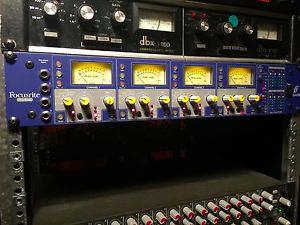
Hugh RobjohnsThe ever-expanding Focusrite range of preamps has just been swelled further with the arrival of the new ISA428 Pre Pack. This is a surprisingly heavy (7kg) rackmount affair which occupies 2U of rack space and extends roughly 250mm behind the front panel. The case is painted black, while the front panel is finished in the classic Focusrite blue colour scheme with grey control sections, yellow knob caps and plenty of LEDs. Dominating the front panel, though, are four moving-coil meters which have been designed with a very fast reaction time and a slow decay to provide an almost peak-reading ballistic, and these show the available headroom.The meters are scaled from -26dB to +2dB with the 0dB point equating to +22dBu at the analogue outputs. An overload LED built into each meter flashes when the signal exceeds this level, although the analogue circuitry actually clips 6dB higher at around +28dBu. The 0dB meter level also equates to the maximum input level for the optional A-D converter card.Each of the four preamp channels is equipped identically and the rear panel bestows each with a balanced mic input XLR socket, a balanced line input TRS socket, a further pair of balanced TRS sockets to provide an insert send and return, and an XLR to carry the balanced channel line output. In addition, the front panel carries four more quarter-inch sockets which accept unbalanced DI instrument inputs, one for each channel. The impedance of these instrument inputs is over 1M(omega).Controls & FacilitiesMoving on to the channel controls now, three illuminated buttons arrayed to the left of each channel's meter engage phantom power, activate a polarity inversion and enable the insert return. Below the meter is one rotary switch and a pair of continuous rotary controls. The switch sets the coarse gain, with the rangedepending on whether the mic or line input is selected, and another illuminated button increases the gain of the mic amp by a further 30dB. The course gain can be set in 10dB steps from zero to 60dB for the mic input, and from -20dB to +10dB for the line input. To allow finer adjustment of the gain, a continuously variable Trim control provides additional gain from zero to +20dB. The combination of maximum course and fine gain settings therefore provides a whopping 80dB of mic gain!Beneath the Trim control another button toggles through the three input options — mic, line and instrument — with LEDs to indicate the current selection. With the instrument input selected, the coarse gain control becomes inactive and the Trim control adopts an alternative gain structure which spans +10dB to +40dB.A second button below the Trim control provides one of the more unusual facilities of the ISA428 — a variable input impedance for the microphone stage. Changing the loading here affects different mics in different ways and is somewhat unpredictable, but adds to the range of tonal colours which can be obtained without resorting to EQ or dynamics. In general, the higher impedance settings tend to provide more signal level and a more open and slightly smoother sound, while lower settings tend to emphasise frequency response peaks and reduce the signal level from the microphone. The button cycles through four options: Low (600(omega)); ISA110 (1400(omega)); Medium (2400(omega)); and High (6800(omega)). These different impedance values are obtained by selecting different taps on the microphone input transformer.The microphone preamp circuitry is the same Rupert Neve design developed for the original Focusrite consoles and the early ISA110 modules. Unlike many of Mr Neve's more recent transformerless designs, this circuit uses a microphone input transformer which provides 20dB of the entire stage gain. The specifications suggest a low noise floor (EIN of -128dBu at 60dB gain with a 150(omega) terminating impedance) and a typically very wide bandwidth (-3dB at 30Hz and 120kHz). The final channel control is a variable high-pass filter with a usefully steep 18dB/octave slope. The corner frequency can be set anywhere from 16Hz to 420Hz and there is a Filter In button to engage or bypass the filter so that its effect on the material can be easily auditioned.Optional A-D ConverterAlthough the ISA428 is available as a straightforward four-channel analogue-onl